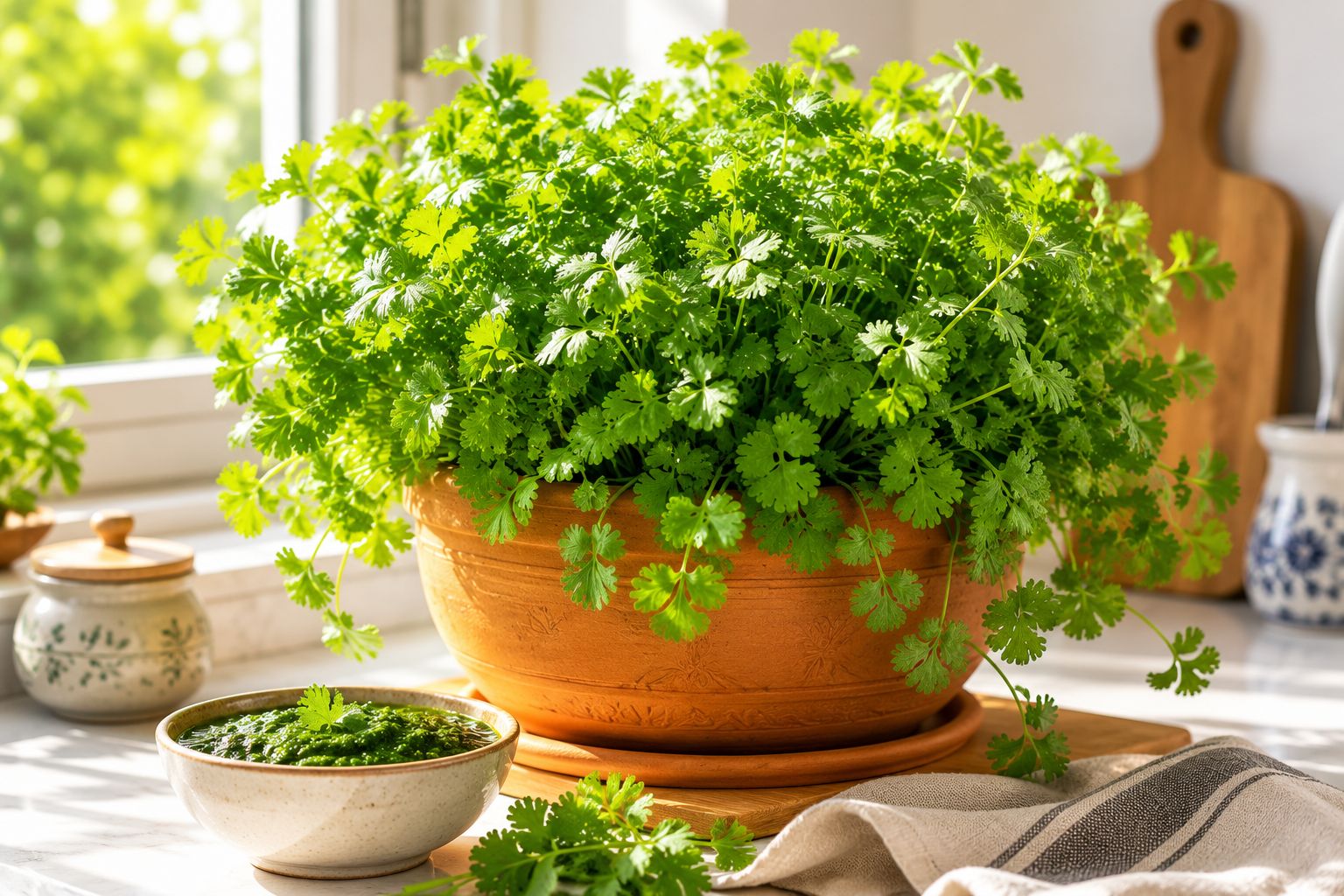
No kitchen can function without Coriander. It goes into the chutney, on top of the daal, scattered over the karahi, chopped through the raita, blended into the biryani masala. It is one of those ingredients that every dish seems to need at the last minute — and it is the one that runs out at the exact wrong moment.
The bunch from the sabzi wala lasts three days in the fridge before it starts going limp and yellow. You throw half of it away every single week.
Here is the fix. Dhaniya is the fastest herb in this entire series — seeds to first harvest in three weeks. It grows in any pot, on any windowsill, with almost no care. And with one simple technique called succession sowing, you can have fresh dhaniya every single week of the year without running out once.
The only trick is understanding how this plant works — because coriander does one thing that catches every beginner off guard. Once you know about it, you will never be frustrated by your dhaniya plant again.
Let us start.
What Is Dhaniya Called Around the World?
| Region | Local Name |
|---|---|
| 🇵🇰 Pakistan / Urdu | دھنیا (Dhaniya) |
| 🇮🇳 Hindi | धनिया (Dhaniya) |
| 🇸🇦 Arabic | كزبرة (Kuzbara) |
| 🇮🇷 Persian / Farsi | گشنیز (Gishniz) |
| 🇫🇷 French | Coriandre |
| 🇲🇽 Spanish | Cilantro |
| 🇬🇧 British English | Coriander |
| 🌐 Scientific | Coriandrum sativum |
🌿 Dhaniya has been used in South Asian, Middle Eastern, and Mediterranean cooking and medicine for thousands of years — historically, coriander has been used as a digestive aid and anti-food poisoning agent across cultures. It is native to the Mediterranean and Asian regions, which is why it grows so naturally and happily in Pakistani conditions. Every part of the plant is edible and useful — the leaves fresh, the seeds dried as a spice, the flowers in salads, and the roots in Southeast Asian cooking.
💡 One thing that confuses people: Coriander and cilantro are the exact same plant. Coriander refers to the seeds and the plant in most of the world. Cilantro is the Spanish word for the leaves, used mainly in the US and Latin America. Dhaniya covers both the leaf and the seed in Pakistan — and both come from Coriandrum sativum.
The One Thing Every Beginner Must Know First: Bolting
Before the steps, there is one thing you need to understand about coriander — because it is what frustrates almost every beginner and causes most people to give up on this herb.
Coriander bolts.
Bolting means the plant decides — usually triggered by heat, long daylight hours, or stress — to stop making leaves and instead shoot up a tall flower spike, produce small white flowers, set seeds, and then die. The whole process can happen in a matter of days. One week you have a lush, leafy plant and the next it has turned into a thin, woody stem reaching for the sky with tiny leaves you can barely use.
This is not a failure. It is the plant's nature. Coriander is an annual — it lives, it produces leaves, it flowers, it sets seed, and it dies. That is the complete life cycle. You cannot permanently stop it from happening. What you can do is manage it.
The two ways to manage bolting:
1. Succession sowing — sow a small batch of seeds every two to three weeks. By the time one batch bolts, the next batch is ready to harvest. This is how you maintain a continuous supply all year. It is the single most important technique in growing dhaniya and the one most beginners skip.
2. Delay it — grow in partial shade during hot weather, water consistently, and harvest regularly. These steps slow the bolt but will not stop it entirely when temperatures climb above 25°C consistently. In Pakistan this means growing dhaniya actively from October through March and using succession sowing through the hotter months.
Now that you know this — the rest is simple.
Step 01 — Get Your Seeds and Prepare Them
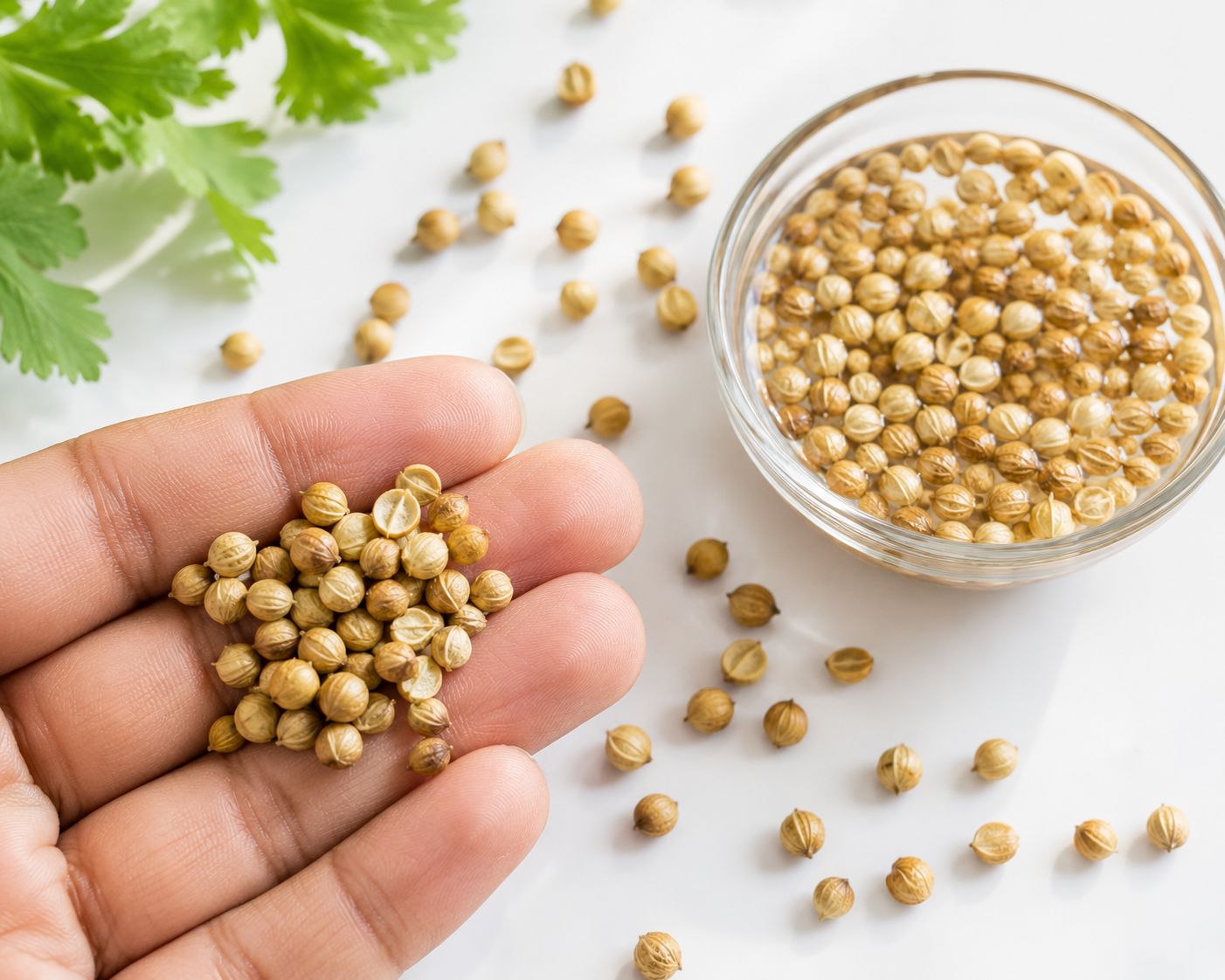
You can get coriander seeds from three places. Any nursery or Seedora. The masala section of your grocery store — the same dhaniya seeds used for cooking work fine for planting. Or your own previous plant, if you have let one bolt and set seed.
The seed trick most guides miss:
Each round coriander seed is technically a fruit containing two seeds inside. If you plant the whole round seed, only one side usually germinates well. Gently crushing or splitting the seed before planting increases your germination rate noticeably — it allows moisture to penetrate the seed husk faster and both seeds inside get a better chance.
Before planting, soak the seeds in water for 24 to 48 hours. The husk needs to be softened so the seedlings can break through it more easily. After soaking, you can either plant them directly or gently crush them between your fingers first.
🌱 Buying tip: If you are using grocery store masala seeds, buy from a fresh stock — old seeds that have been sitting on shelves for a year have significantly lower germination rates. Seeds should smell fragrant when crushed. If they smell like nothing, they are too old.
Step 02 — Pot and Soil
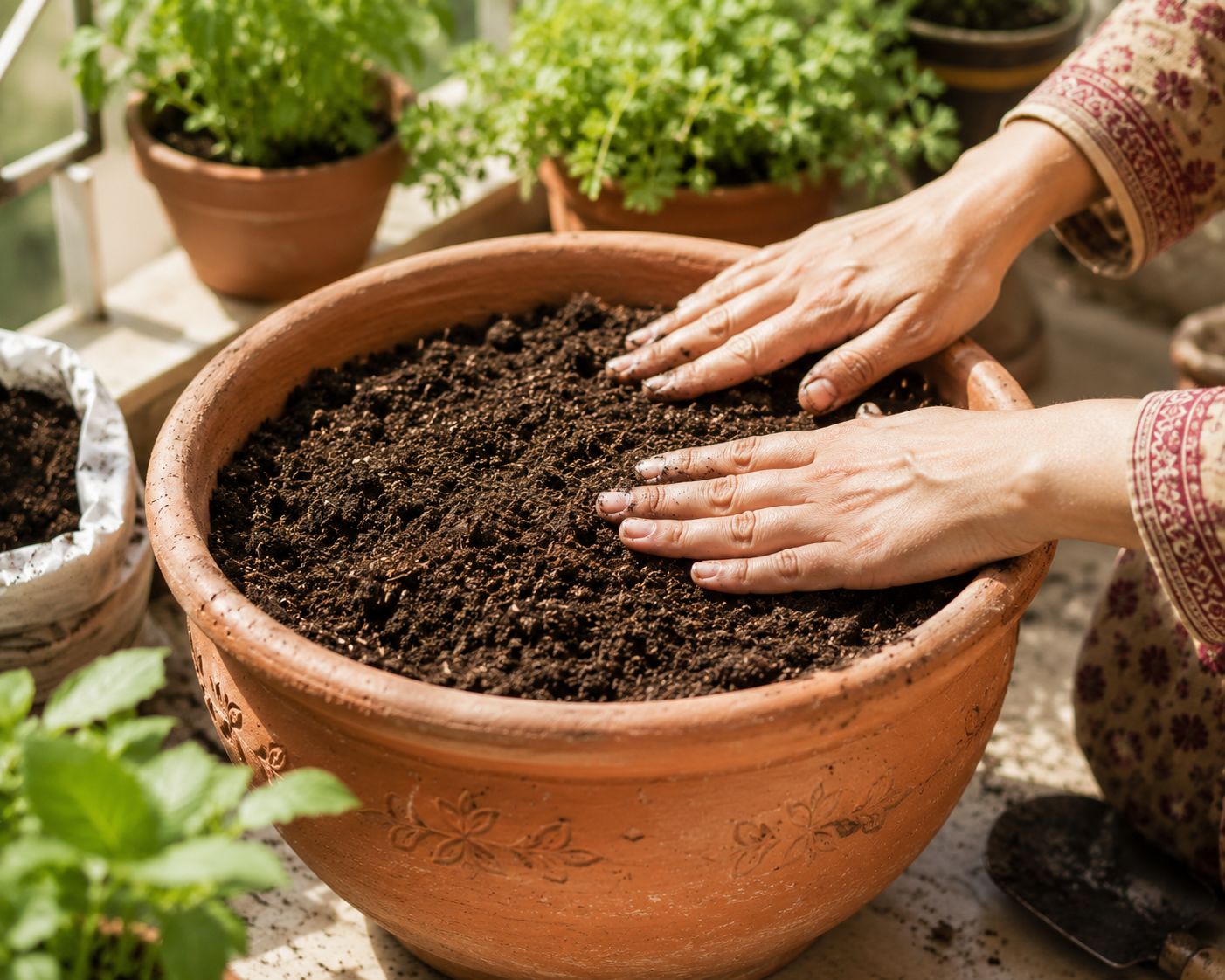
Coriander has one important root feature that changes how you grow it: a long tap root. This tap root grows straight down and does not like to be disturbed. This means two things for how you set up your pot.
Sow directly where it will grow. Coriander is best sown directly in pots rather than growing in seed trays and transplanting. Transplanting almost always damages the tap root and causes the plant to bolt or die prematurely. Put the seed where you want the plant to live and leave it there.
Choose a pot that is deep enough. Use a pot at least 20 to 25 cm deep to give the taproot room to develop fully. Width matters too — a wider pot lets you sow multiple seeds and get a denser harvest. A good all-rounder for balcony dhaniya is a pot roughly 30 cm wide and 25 cm deep.
Soil: Coriander thrives in well-draining soil with a slightly acidic to neutral pH of 6.2 to 6.8. Use good quality potting mix with some compost mixed in. Avoid clay-heavy soil — it retains too much water and causes the very root rot that kills coriander fastest. A mix of 60% potting soil and 40% compost gives you the balance of nutrients and drainage this herb needs.
| Care | Requirement |
|---|---|
| ☀️ Sunlight | 4–6 hours — morning sun best; afternoon shade in summer |
| 💧 Watering | When top inch of soil is dry — every 2–3 days |
| 🌡️ Temperature | 12–25°C ideal — bolts above 28°C consistently |
| 🪴 Pot | 25 cm deep minimum — sow directly, do not transplant |
| 🌱 Soil | Well-draining, compost-rich — pH 6.2 to 6.8 |
| 📅 Best time to plant (Pakistan) | October – March for best results; year-round with shade |
Step 03 — Sow the Seeds
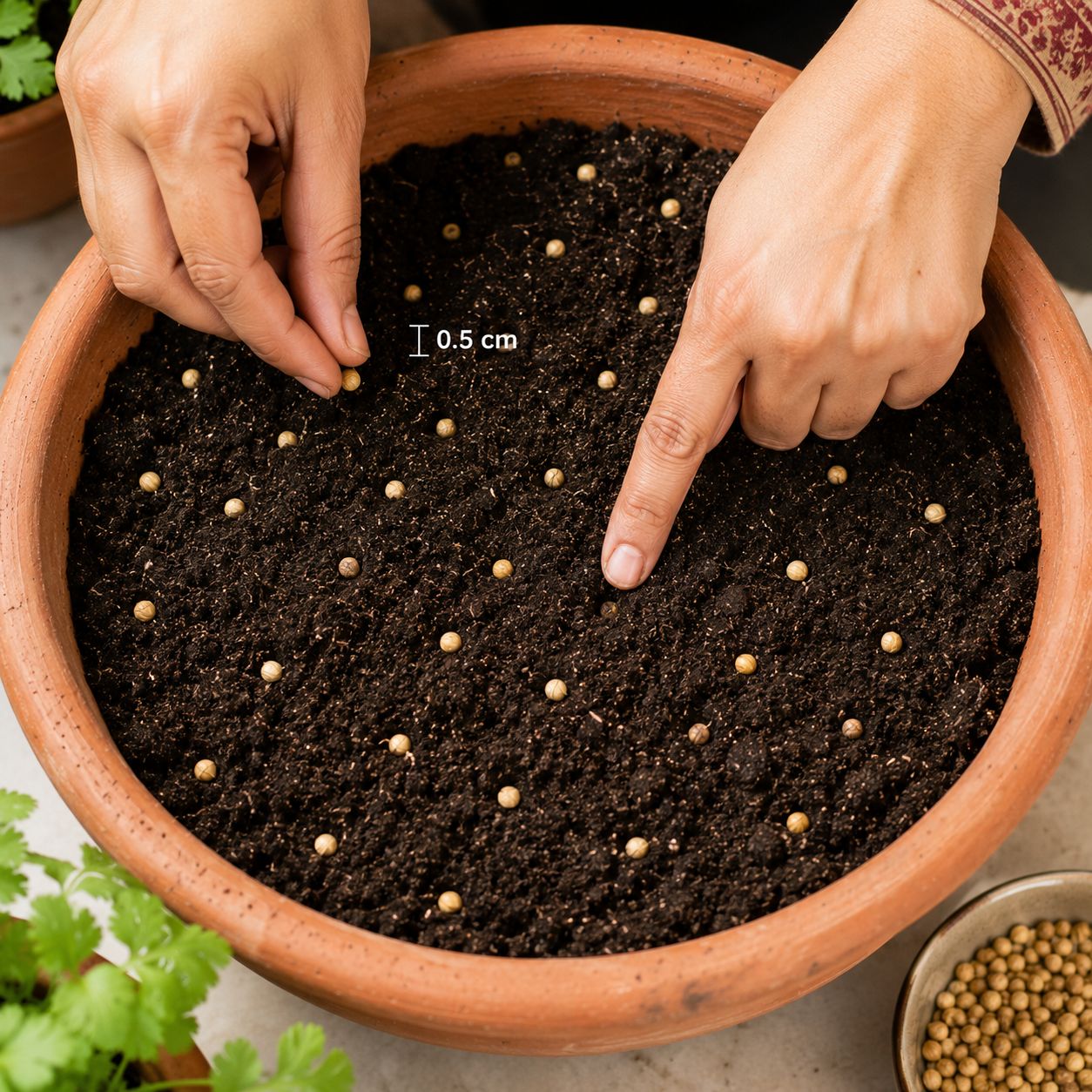
Fill your pot with the prepared soil mix to within 3 cm of the rim. Sow your prepared seeds about half to one centimetre deep. Space seeds roughly 6 to 8 cm apart — this gives each plant enough room to develop without competing too intensely for nutrients.
Press the soil lightly over the seeds and cover with a thin layer of fine soil or compost. Water gently using a watering can with a rose head or a spray bottle — a strong stream of water will wash the seeds to one side or drive them too deep.
Place the pot in a warm spot with good light. Keep the soil consistently moist during germination — coriander seeds require plenty of moisture to germinate, so make sure to water them frequently during this phase.
Seeds should germinate within 7 to 20 days depending on temperature and seed freshness. Once you see the first small, fern-like leaves pushing through the soil, the hardest part is done.
💡 Sow thickly for cutting as a crop. If you want to harvest coriander like a cut-and-come-again salad leaf — cutting it when young and letting it regrow — sow seeds more densely, almost like scattering. This gives you a dense, lush mat of young leaves for several harvests before the plants get crowded and need replacing.
Step 04 — Care and Watering
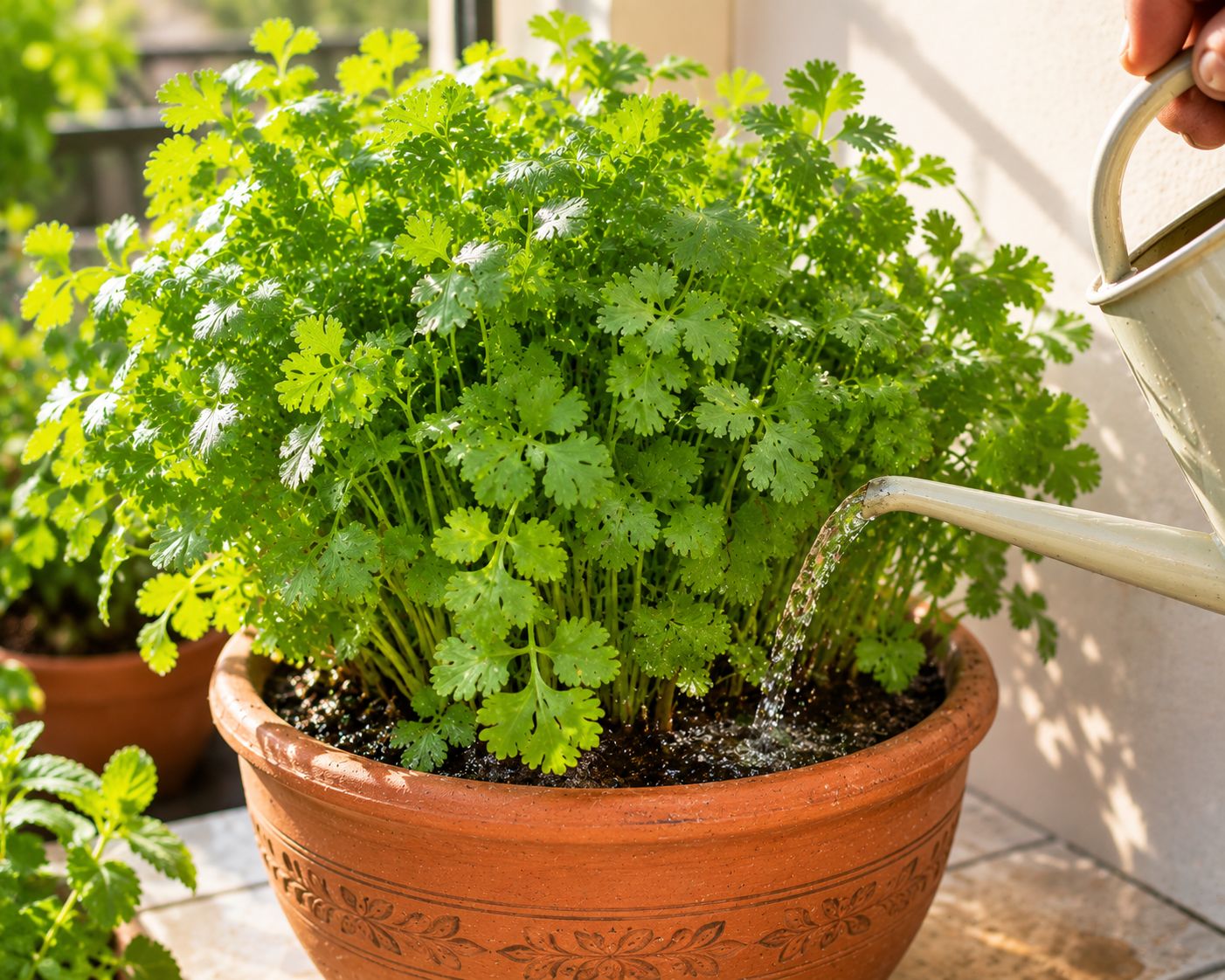
Once your dhaniya is growing, the care is minimal but consistent.
Watering: Coriander does not require frequent watering — water only when the top inch of soil is dry to the touch. The soil should begin to dry out within two to three days between waterings. This herb is prone to root rot, so avoid overwatering. At the same time, in Pakistani heat during spring and early summer, check the pot daily — containers dry out far faster than garden soil.
Sunlight: Dhaniya grows best in full sun but will tolerate and actually benefit from partial shade when temperatures climb. In summer, sow in a cooler location out of midday sun — morning sun and afternoon shade is the sweet spot. In Pakistani winters from October through February, place it in the sunniest spot available.
Feeding: Coriander is not a heavy feeder — it does not need the fertilising schedule that shimla mirch or tomatoes demand. A single application of diluted liquid fertiliser or compost tea once a month is enough to keep growth lush and flavourful. Avoid heavy nitrogen feeds — they promote rapid leafy growth that bolts faster.
The key sign to watch for: When coriander plants reach about 6 inches tall and start to look as if the leaves are getting smaller and more feathery at the top, the plant is thinking about bolting. This is your signal to harvest everything usable now, before it sends up the flower spike.
Step 05 — Harvest the Right Way
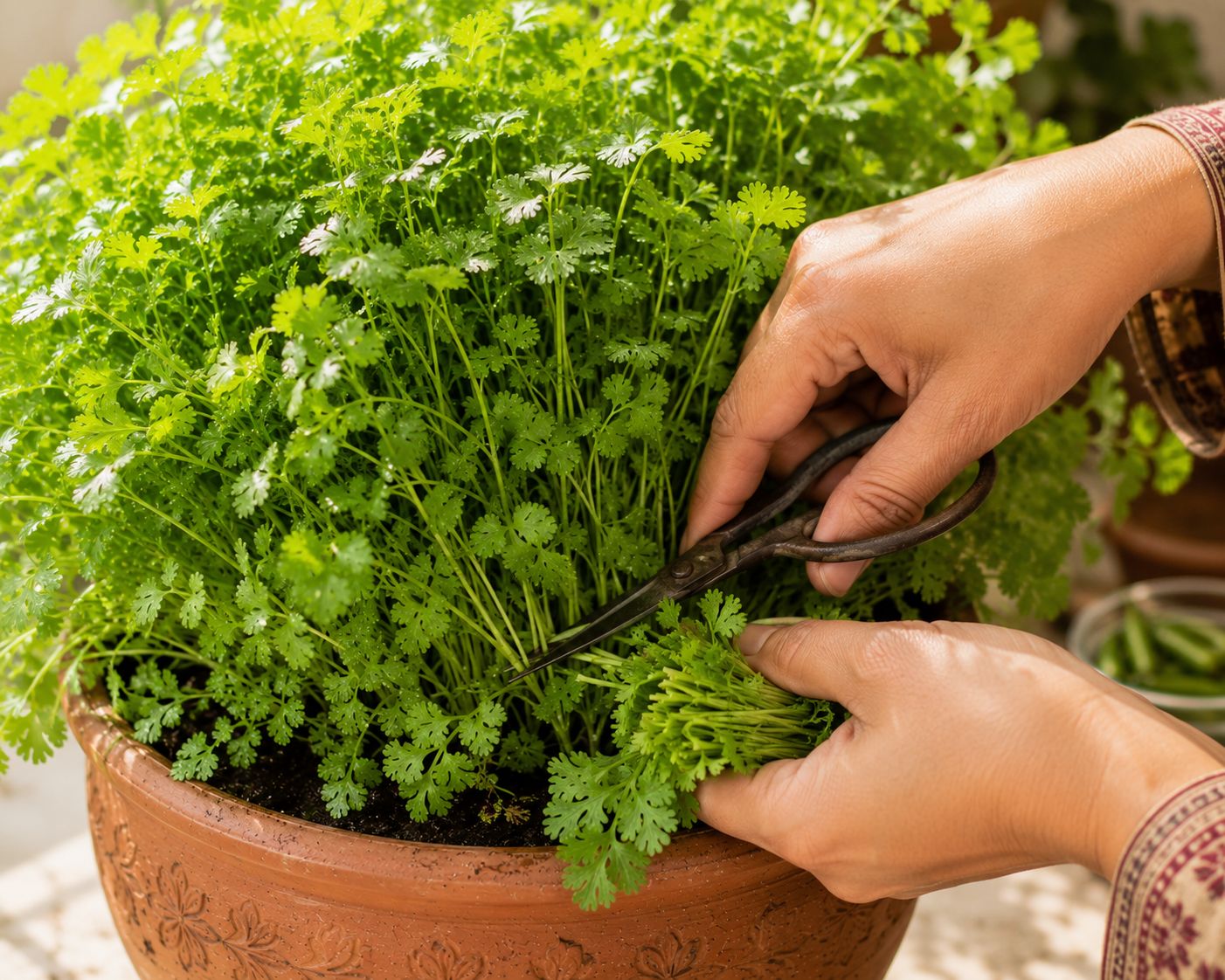
Your dhaniya is ready to harvest when the plants reach about 10 to 15 cm tall — typically three to four weeks after sowing, sometimes faster in warm conditions.
How to harvest for continuous growth:
Harvest regularly to encourage bushier growth and prevent flowering. Snip leaves off at the base of the stalk — the stalk is also full of flavour and can be chopped into cooking. Never strip all the leaves from any single stem — always leave some growth behind so the plant can continue photosynthesising and recovering.
Take no more than one third of any plant at a time. Harvest from the outside of the plant inward, taking the older outer leaves and leaving the centre growth intact — this encourages the plant to keep pushing out new leaves from the middle.
The cut-and-come-again technique: Once plants are established, snip across the whole top of the pot — cutting all stems about 3 cm above soil level. The plants will regrow from the base and give you another full harvest in one to two weeks. This technique gives you two to three complete harvests from a single sowing before the plants bolt.
✂️ Do not wait for a perfect moment to harvest. Harvesting regularly is what delays bolting. A plant that is frequently harvested stays in leaf production mode longer than one left to grow unchecked. Every time you take leaves, you are telling the plant to keep making more.
The Succession Sowing Calendar — Never Run Out Again
This is the technique that separates people who always have fresh dhaniya from people who always seem to be out of it.
Every two to three weeks, sow a small new batch of seeds in a fresh pot or a cleared section of an existing pot. By the time your first batch bolts and dies, your second batch is ready to harvest. By the time your second batch bolts, your third is ready.
Suggested Pakistan calendar:
| Month | Action |
|---|---|
| October | Sow Batch 1 — peak season begins |
| November | Sow Batch 2 — harvest Batch 1 |
| December | Sow Batch 3 — harvest Batch 2 |
| January | Sow Batch 4 — harvest Batch 3 |
| February | Sow Batch 5 — harvest Batch 4 |
| March | Sow Batch 6 — harvest Batch 5, heat rising |
| April–September | Sow in partial shade only, accept faster bolting |
Three pots rotating in this way give you a continuous supply of fresh dhaniya through the entire cool season and into summer with shade management.
Bonus: Letting It Bolt Has a Reward
When your dhaniya plant does bolt — and it will eventually — do not pull it up in frustration. Let it flower. Let it set seed. And then harvest those seeds.
The small white flowers that appear when coriander bolts are edible and beautiful — they can be harvested and eaten in salads, used as garnish, or left for pollinator insects. After flowering, the plant will produce green seed pods. You can harvest these green seeds and use them as a fresh spice with a bright, citrusy zing — different from dried coriander seeds and genuinely delicious.
If you want to harvest dried coriander seeds — the same ones used in garam masala and curry powder — wait until the seeds turn light brown on the plant. Then cut the entire stem, place the seed heads in a paper bag, and hang upside down somewhere dry for a few weeks. Shake the bag and the seeds fall free. Store in an airtight container and use whole or ground.
🌱 Save some seeds for replanting. You can probably harvest enough seeds from three plants to sow dhaniya continuously for an entire year — for free. This is the ultimate self-sufficient kitchen herb cycle.
How to Use Fresh Dhaniya Every Day
- 🫙 Blended with green chili, lemon, and a pinch of salt for the most essential Pakistani green chutney
- 🍚 Scattered generously over daal, karahi, biryani, or pulao just before serving
- 🥗 Chopped through raita with yoghurt, cucumber, and cumin
- 🍳 Chopped into omelettes or egg bhurji for freshness and colour
- 🍲 Stirred through shorba or soup in the last minute of cooking
- 🫙 Blended into coriander-mint chutney — the combination is better than either alone
- 🌮 Used as a fresh garnish on chaat, gol gappa filling, and dahi puri
How to Keep Fresh Dhaniya After Harvesting
The sabzi mandi trick that actually works — and why it works better than any other method.
Method 1 — Water Glass (Lasts 2 Weeks)
Trim the stems, stand in a glass with 3–4 cm of water, cover loosely with a plastic bag, and refrigerate. Change the water every two days. Coriander treated like flowers stays bright and fragrant for up to two weeks this way.
Method 2 — Damp Paper Towel (5–7 Days)
Wrap loosely in a damp paper towel, place in a zip-lock bag with a little air, refrigerate. Good for a week of daily use.
Method 3 — Freeze for Cooking (3–4 Months)
Wash, dry completely, chop finely, and freeze in small portions in an ice cube tray with a little water or oil. Pop a cube directly into cooking from frozen — the flavour holds remarkably well for cooked dishes, daal, and curries.
Common Mistakes to Avoid
| Mistake | What Happens | The Fix |
|---|---|---|
| Transplanting seedlings | Damages tap root, plant bolts or dies | Sow directly where it will grow — never transplant |
| Not soaking seeds first | Slow, patchy germination | Soak 24–48 hours, gently crush before sowing |
| Too much heat and sun | Bolts within days | Afternoon shade in summer, morning sun only |
| Watering too much | Root rot, yellow leaves | Water only when top inch of soil is dry |
| Planting only once | Always running out | Sow a new batch every 2–3 weeks — succession sowing |
| Harvesting from the bottom | Strips the plant bare | Always snip from the top and outer leaves |
| Pulling up a bolted plant | Lose free seeds for next sowing | Let it flower, set seed, then harvest dried seeds |
| Pot too shallow | Tap root restricted, plant bolts early | Minimum 20–25 cm depth |
Dhaniya vs Other Herbs in This Series
| Dhaniya | Mint | Ginger | Garlic | |
|---|---|---|---|---|
| Time to first harvest | 3–4 weeks | 3–4 weeks | 3–4 months (baby) | 6–8 months |
| Grows from | Seed | Stem cutting | Rhizome | Clove |
| Season | Cool — Oct to March best | Year round | Spring-Summer | Winter crop |
| Replants itself | ✅ Self-seeds if left to bolt | ✅ Forever | ✅ Forever | ✅ Every year |
| Pakistan kitchen use | ✅ Every dish | ✅ Daily | ✅ Every dish | ✅ Every dish |
| Difficulty | ⭐ Easiest | ⭐ Easiest | ⭐⭐ Easy-Medium | ⭐⭐ Easy-Medium |
| Bolts in heat | ✅ Yes — manage with shade | ❌ | ❌ | ❌ |
Dhaniya is the fastest, most immediately useful, and most daily-use herb in this entire series. Start it this week. Sow another batch in three weeks. Keep that cycle going and your kitchen will never be without fresh dhaniya again.
Part of the Instantly Grow Series by Seedora Store — grow the herbs your kitchen actually uses, every single day.