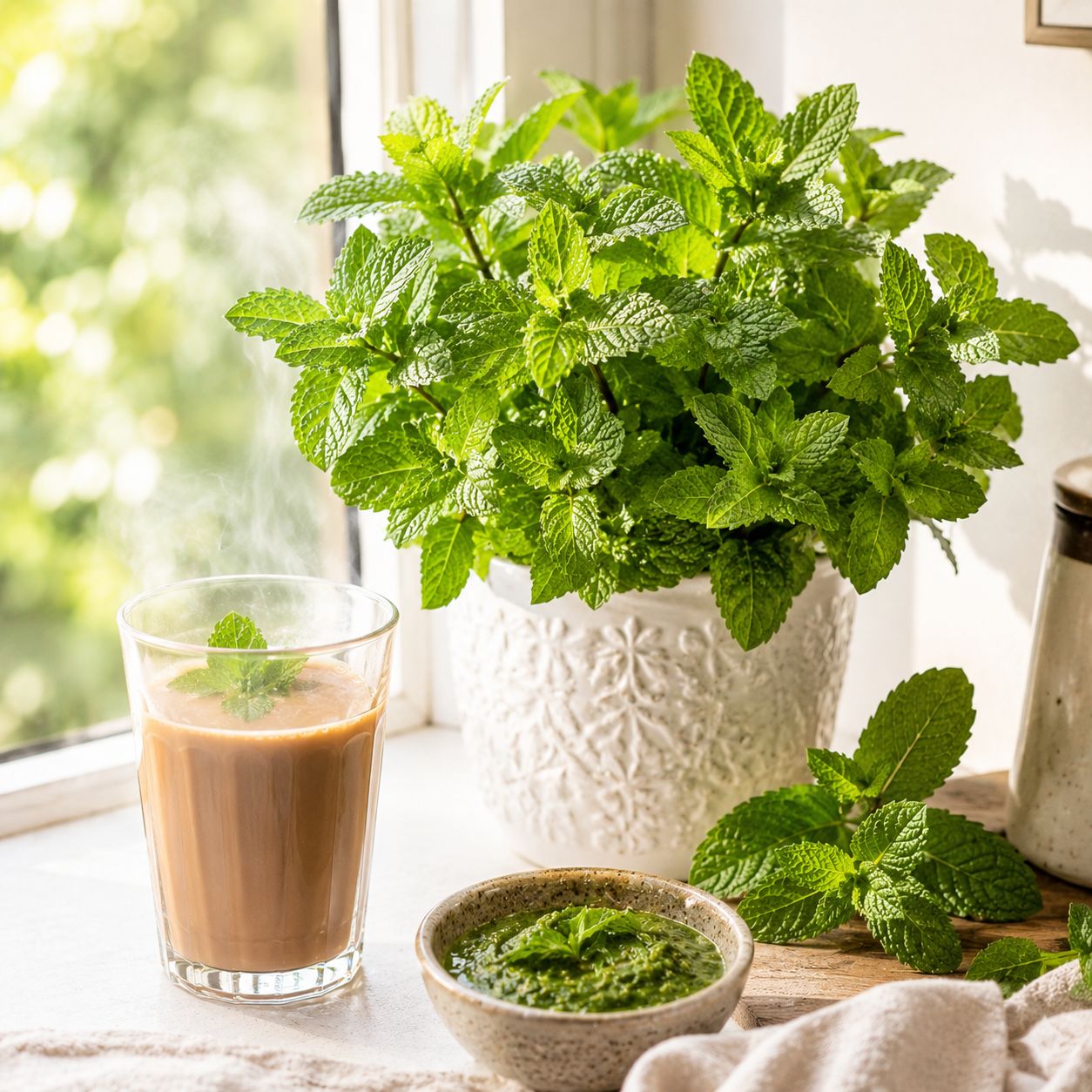
Let's be honest. Every kitchen needs pudina. Not the sad wilted bunch from the sabzi wala that lasts two days in the fridge. Fresh pudina. Bright green, intensely fragrant, snapped off the stem thirty seconds before it goes into your chai, your raita, your chutney, your lemonade.
Mint is the one herb that almost grows itself. Stick a stem in a glass of water on your windowsill and come back in a week. You will have roots. Plant it in a pot and in a month you have more mint than you know what to do with. Share stems with your neighbours. Fill every pot in your kitchen. It does not stop.
This is the easiest herb you will ever grow. Here is exactly how.
What Is Mint Called Around the World?
| Region | Local Name |
|---|---|
| 🇵🇰 Pakistan / Urdu | پودینہ (Pudina) |
| 🇸🇦 Arabic | نعناع (Naanaa) |
| 🇮🇳 Hindi | पुदीना (Pudina) |
| 🇮🇷 Persian / Farsi | نعنا (Naana) |
| 🇫🇷 French | Menthe |
| 🇮🇹 Italy | Menta |
| 🇩🇪 Germany | Minze |
| 🌐 Scientific | Mentha spicata (Spearmint) / Mentha piperita (Peppermint) |
🌿 Pudina has been used in Pakistani and South Asian cooking and medicine for centuries — in chai, digestive drinks, summer coolers, and Unani remedies for stomach issues. It is one of the most culturally embedded herbs in our entire food tradition.
Which Mint Should You Grow?
| Variety | Flavour | Best Use | Easiest? |
|---|---|---|---|
| Spearmint (Mentha spicata) | Sweet, mild, classic pudina | Chai, raita, chutney, cooking | ✅ Easiest |
| Peppermint (Mentha piperita) | Strong, cool, intense | Tea, mojitos, digestive drinks | ✅ Easy |
| Apple Mint | Soft, fruity, gentle | Fruit drinks, salads | ✅ Easy |
| Chocolate Mint | Minty with cocoa undertone | Desserts, hot chocolate | ✅ Easy |
| Moroccan Mint | Very sweet, strong | Traditional mint tea | ✅ Easy |
💡 Spearmint is what you want for the classic Pakistani pudina experience — the one that goes in your chai and chutney. It is the easiest to grow and the most versatile in the kitchen. Everything in this guide applies to spearmint first, but works for all varieties.
Why Mint Belongs in Every Pakistani Home
🍵 Fresh Pudina Chai — There is no comparison between dried mint and fresh mint in tea. A few leaves dropped into your chai changes the entire character of the cup. Warm, sweet, slightly cooling all at once.
🥗 Raita and Chutney On Demand — Never buy a wilted bunch from the sabzi wala again. Step to your windowsill, snap off what you need, and the flavour of fresh pudina chutney versus made-from-old-mint chutney is a completely different thing.
🫁 Digestive Relief — Mint has been used in Unani medicine for centuries for nausea, bloating, and indigestion. Fresh mint tea after a heavy meal genuinely soothes the stomach — menthol activates cold-sensitive receptors that relieve gut discomfort.
❄️ Natural Cooling Effect — Menthol in mint creates a genuine cooling sensation in the body. In Pakistani summers this matters more than almost any other herb you can grow.
🦟 Repels Insects — The strong menthol fragrance keeps mosquitoes, ants, and flies away from your kitchen naturally. A pot near your window is better than most sprays.
🧠 Sharpens Focus — Simply smelling mint improves alertness, memory, and reaction time according to multiple studies. Keep it near your study space or work desk.
💚 Spreads Forever for Free — Mint spreads aggressively through underground runners. One pot becomes two becomes four. You will never run out and you will always have stems to share.
Step 01 — Get a Stem From Your Kitchen
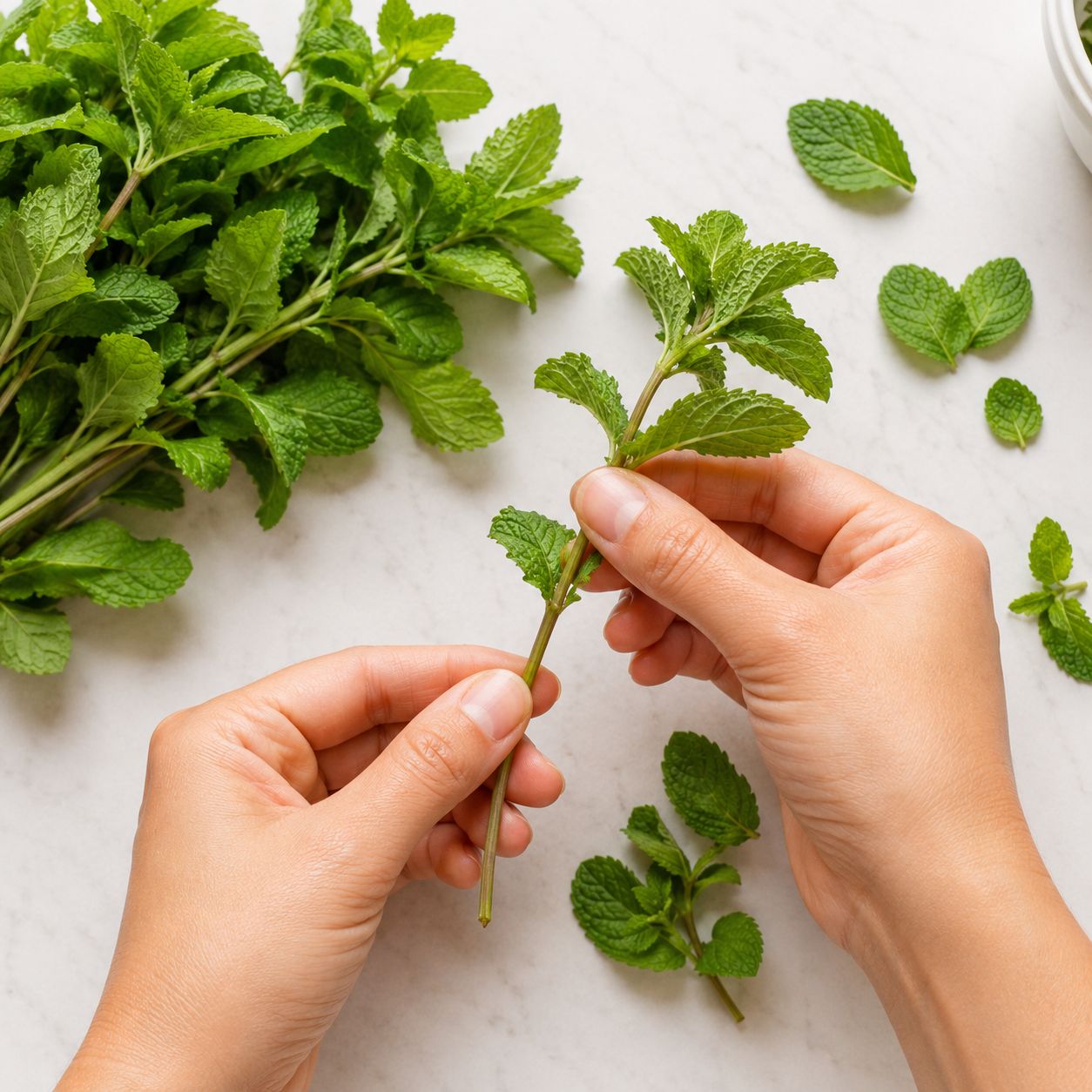
Here is something beautiful about mint — you already have what you need to start.
Go to any grocery store, sabzi mandi, or even a roadside thela and buy a fresh bunch of pudina. Pick the freshest one you can find — bright green, firm stems, intensely fragrant. That bunch sitting in your kitchen right now is full of potential plants.
Pick 3–4 stems that are 10–15 cm long with healthy leaves. Remove all leaves from the bottom half of each stem — leaving just the top cluster of leaves intact. The bare nodes on the lower stem are exactly where roots will emerge.
That is it. Your cutting is ready. The whole process takes about two minutes.
🌱 One important thing: the stem must have at least 2–3 nodes — those small bumps or leaf joints along the stem. That is where the roots come from. No nodes = no roots.
Step 02 — Root in Water (The Fastest Way)
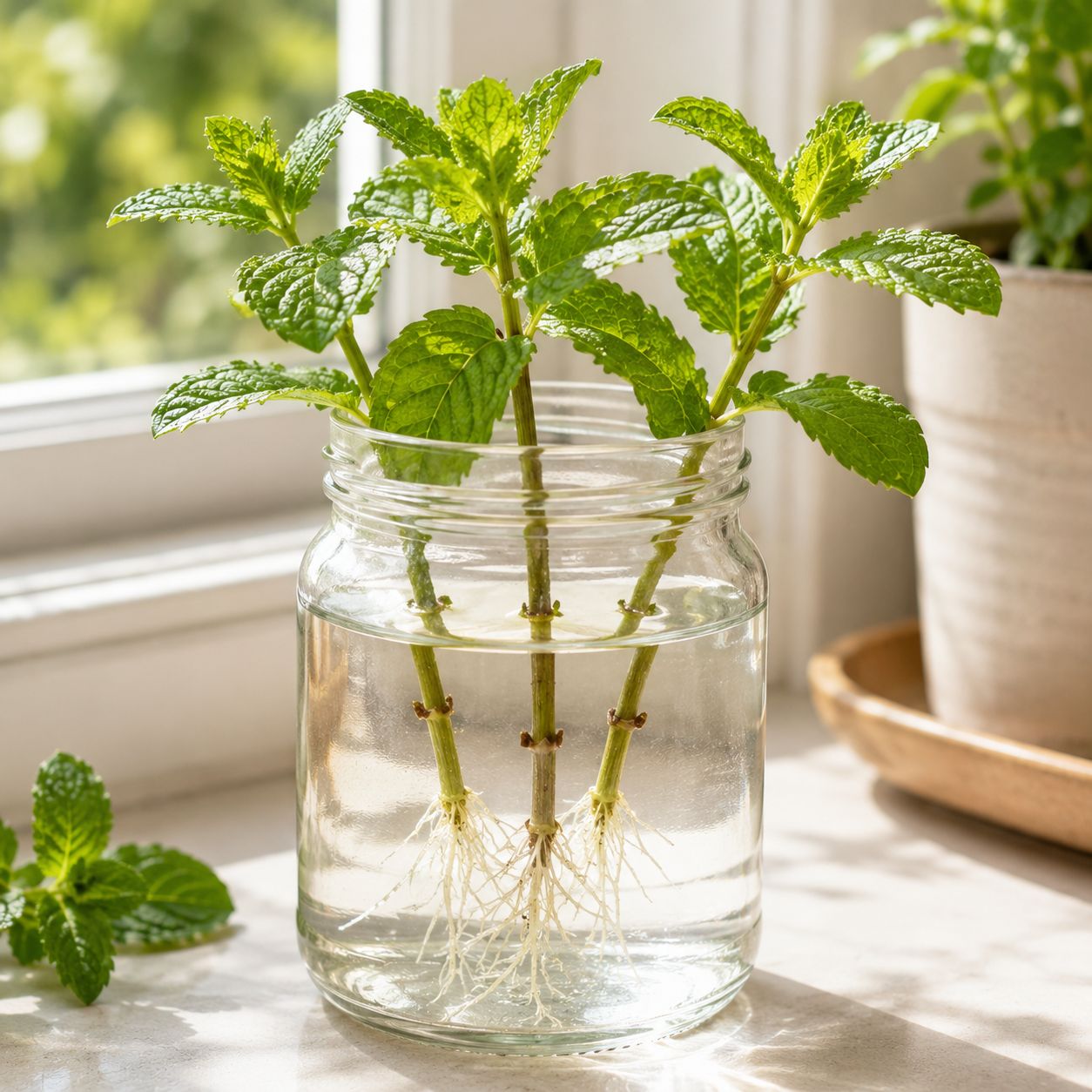
Drop your prepared stems into a glass or jar of water — just deep eno
ugh to submerge the bare lower nodes, about 4–5 cm. Keep the leafy tops above water completely. Place on your brightest windowsill.
Now watch what happens. Mint roots faster than almost any herb on this list. Within 5–7 days you will see tiny white roots pushing out from the nodes. Within 10–14 days those roots will be long enough to plant. It is one of the most satisfying things to watch happen on a kitchen windowsill.
Change the water every 3–4 days to keep it fresh and prevent any algae or smell. Use room temperature water — cold water from the fridge slows root development.
💡 Keep mint in water permanently if you prefer. Many people never bother planting it in soil at all. A glass of mint on the windowsill, changed weekly, will grow and produce leaves for months. Entirely your choice.
Step 03 — Plant and Contain It
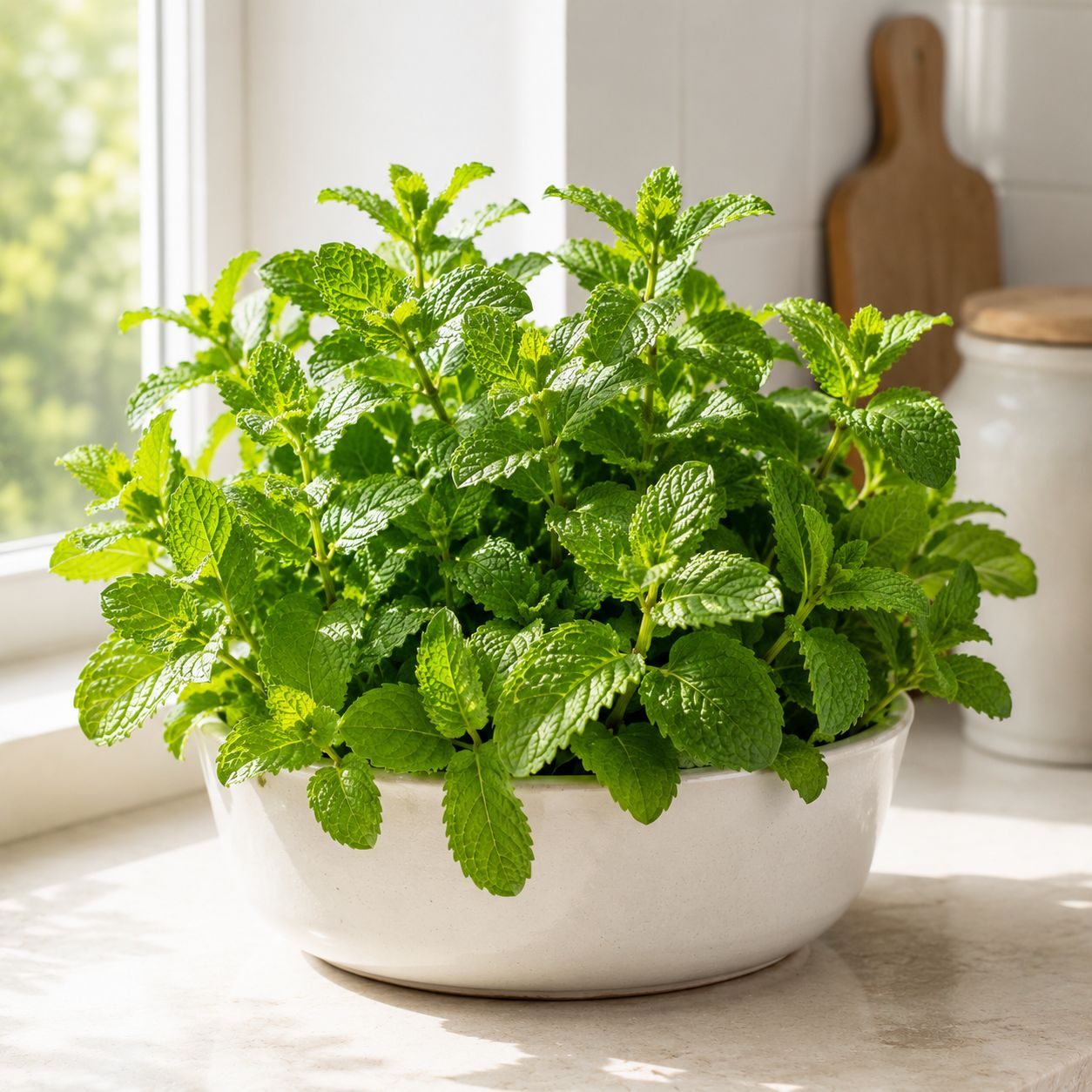
Once roots are 3–5 cm long — plant into a pot. And here is the one thing you absolutely must know about mint before you do.
Mint spreads. Aggressively. Unstoppably.
Underground runners shoot out in every direction and mint will take over any space it is given. This is not a problem — it is a feature — as long as you manage it correctly.
Always grow mint in its own dedicated pot. Never plant it directly in a garden bed or alongside other herbs. It will crowd and kill everything near it within one season.
Use a wide, shallow pot rather than a tall deep one — mint spreads outward more than downward. Fill with regular potting mix — mint is not fussy about soil quality at all. Plant your rooted cuttings 2–3 cm deep and water in well.
Place in bright indirect light to full sun — 4 to 6 hours daily minimum. Mint tolerates lower light better than most herbs but produces the most flavourful, fragrant leaves in good sun.
Water when the top 2 cm of soil feels dry — mint likes consistent moisture but hates standing water. It will wilt dramatically when thirsty and spring back just as dramatically when watered. Do not panic when it droops — just water it.
| Care | Requirement |
|---|---|
| ☀️ Sunlight | 4–6 hours — tolerates partial shade |
| 💧 Watering | Keep consistently moist — every 3–5 days |
| 🌡️ Temperature | 15–25°C ideal — handles Pakistani winters |
| 🪴 Pot | Wide and shallow — dedicated pot only |
| 🌱 Soil | Regular potting mix — not fussy |
| 📅 Best time to plant (Pakistan) | Year round — best in winter/spring |
Step 04 — Harvest the Right Way and Get More Forever
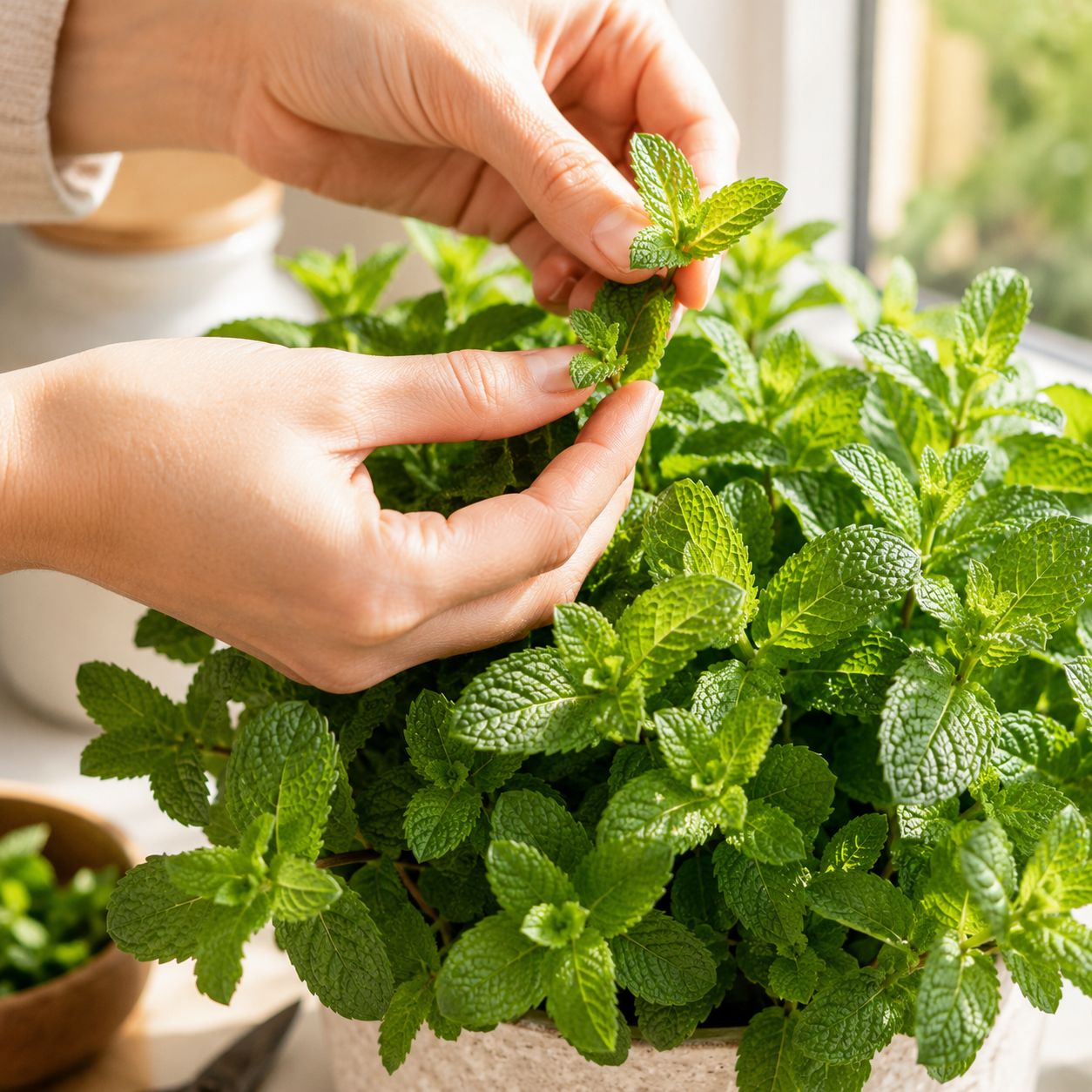
Your mint is ready to harvest when it reaches 10–15 cm tall — usually 3–4 weeks after planting rooted cuttings. And the way you harvest determines everything about how productive your plant becomes.
Always pinch or cut from the top — the growing tip of each stem. Never strip leaves from the bottom up. Pinching the top does two things simultaneously — it removes the material you want to use and it signals the plant to branch out and produce two new stems where one was. Every harvest makes the plant bushier and more productive.
Harvest before flowering. When mint flowers — small pale purple spikes that appear in summer — the leaves lose significant flavour intensity. The moment you see flower buds forming, pinch them off immediately. No flowers = more leaves = better flavour all season.
How to use fresh mint every day:
- 🍵 3–4 leaves torn into your chai in the last 30 seconds of brewing
- 🥗 Handful chopped into raita with yoghurt, cucumber, and cumin
- 🫙 Blended with coriander, green chili, lemon for the best chutney you have ever made
- 🍋 Muddled in lemonade or lassi with sugar and lemon juice
- 💊 3–4 leaves steeped in hot water for a simple digestive tea after meals
- 🧊 Frozen in ice cubes for summer drinks
✂️ The golden rule: Never harvest more than one third of the plant at once. Always leave enough leaves for the plant to keep photosynthesising and bouncing back. A plant consistently harvested this way produces for months without slowing down.
How to Make Mint Last Longer After Harvesting
Most people put mint in the fridge and watch it go black and limp within two days. Here is what actually works.
Method 1 — Water Glass (Best)
Treat cut mint exactly like flowers. Trim the stems, put in a glass with 3–4 cm of water, cover loosely with a plastic bag, refrigerate. Changes the water every 2 days. Mint stays fresh and fragrant for up to 2 weeks this way.
Method 2 — Damp Paper Towel
Wrap loose mint in a damp paper towel, place in a zip-lock bag with a little air inside, refrigerate. Good for 5–7 days.
Method 3 — Freeze It
Wash, dry completely, spread on a tray and freeze for 2 hours, then bag and store. Frozen mint goes straight into chai or cooking and tastes almost fresh. Lasts 3–4 months.
Common Mistakes to Avoid
| Mistake | What Happens | The Fix |
|---|---|---|
| Planting in garden bed | Takes over everything | Always in its own dedicated pot |
| Not enough water | Dramatic wilting | Keep consistently moist |
| Letting it flower | Leaves lose flavour | Pinch flower buds immediately |
| Harvesting from bottom | Bare leggy stems | Always pinch from the top |
| Too much direct harsh sun | Scorched, bitter leaves | Bright indirect or morning sun |
| One large harvest | Plant stress, slow recovery | Never more than one third at once |
Mint vs Other Easy Kitchen Herbs
| Mint | Basil | Coriander | Rosemary | Chamomile | |
|---|---|---|---|---|---|
| Roots in water | ✅ 5–7 days | ✅ 7–10 days | ❌ Seed only | ✅ 3–5 weeks | ❌ Seed only |
| First harvest | 3–4 weeks | 3–4 weeks | 3–4 weeks | 4–6 months | 8–10 weeks |
| Lasts how long | Years | One season | One season | 10–15 years | One season |
| Pakistan kitchen use | ✅ Daily | ✅ Often | ✅ Daily | ✅ Cooking | ✅ Tea only |
| Spreads on its own | ✅ Aggressively | ❌ | ❌ | ❌ | ✅ Self-seeds |
| Grows in water only | ✅ Yes | ✅ Yes | ❌ | ❌ | ❌ |
| Difficulty | ⭐ Easiest | ⭐ Easy | ⭐ Easy | ⭐⭐ Medium | ⭐ Easy |
Mint is the fastest, most immediately useful, most culturally relevant herb you can grow in a Pakistani kitchen. Start here before anything else.
Part of the Instantly Grow Series by Seedora Store — grow the herbs your kitchen actually uses, every single day.