The navel orange has existed for over 150 years. Every single one of them — every navel orange grown anywhere on earth since the 1870s — descends from a single mutant tree that appeared in a monastery in Bahia, Brazil. The tree could not reproduce. Its fruit contained no seeds.
A cutting was sent to the USDA. Distributed to California growers.Grafted and grown and grafted again. The process continues today.Every navel orange you have ever eaten was a clone.
We call this convenience. But it is worth asking — who decided that? And who profits from it every single year?
Who Controls the Seeds That Remain
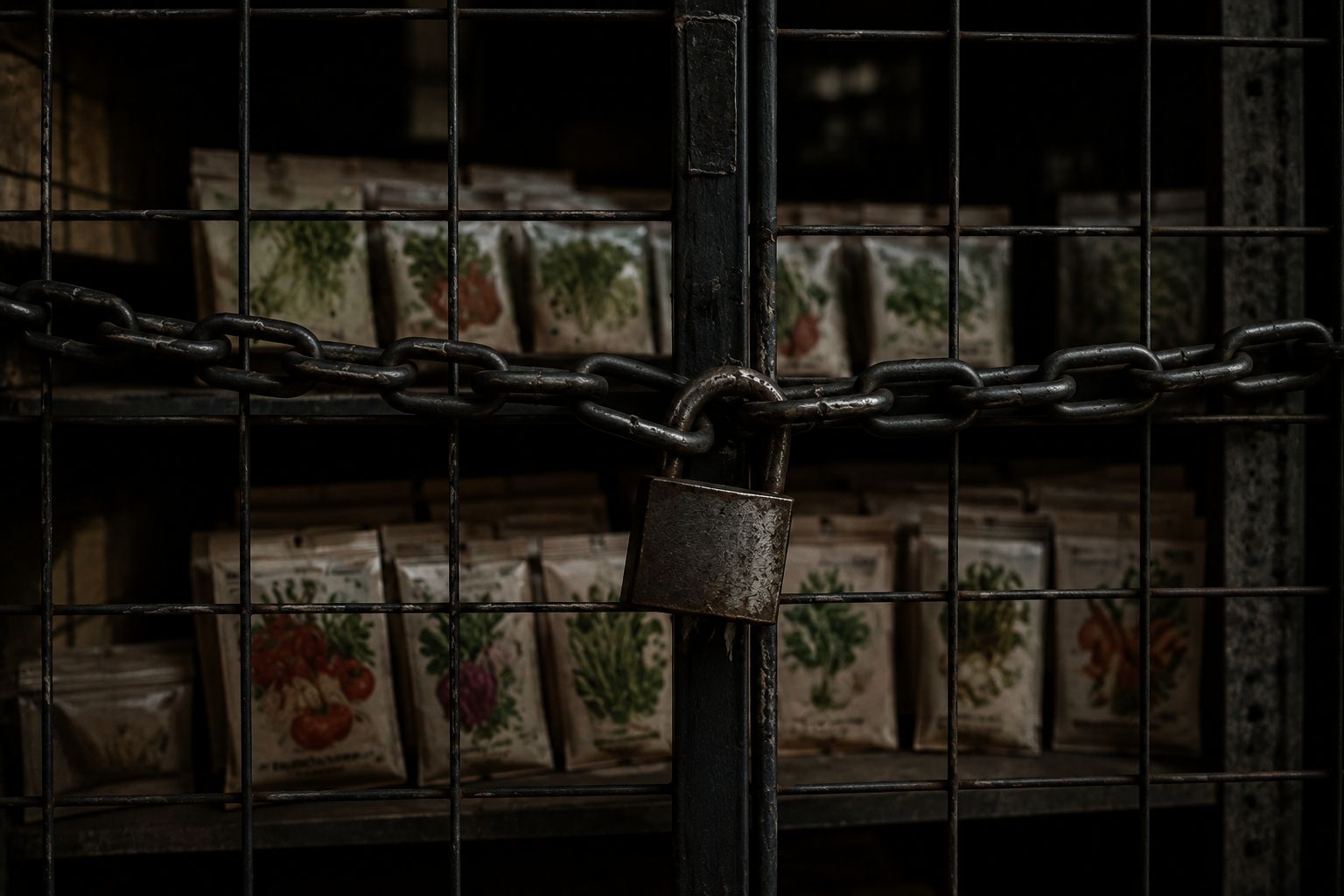
Four corporations — Bayer, Corteva, ChemChina-Syngenta, and BASF — now control more than 50 percent of the global seed market.
In 1996, there were approximately 7,000 independent seed companies globally. Today, four companies dominate a market that once had thousands of participants.
The mechanism of control is the patent. Since a 1980 US Supreme Court decision opened the door to patents on living organisms, corporations have patented not just seed varieties but genetic traits, breeding methods, and biological processes. Corteva alone has applied for more than 1,400 GMO-related patents, according to Corporate Europe Observatory's 2022 report.
The practical consequence: seeds under utility patent cannot be saved, replanted, shared, or sold. A farmer who buys patented seed must buy new seed from the same corporation every single year.The practice of seed saving — which fed human beings for ten thousand years — becomes legally prohibited.
The Center for Food Safety documented that Monsanto — now Bayer — filed hundreds of lawsuits against farmers for alleged seed-saving violations, including cases where patented varieties had drifted into fields through wind pollination without the farmer's knowledge.
60 percent of the world's seed supply. Owned by four chemical companies. The same companies that control the pesticide market. Engineering seeds that require their own branded chemicals — so farmers must buy both from the same corporation, every year, without exit.
What This Has to Do With Your Watermelon
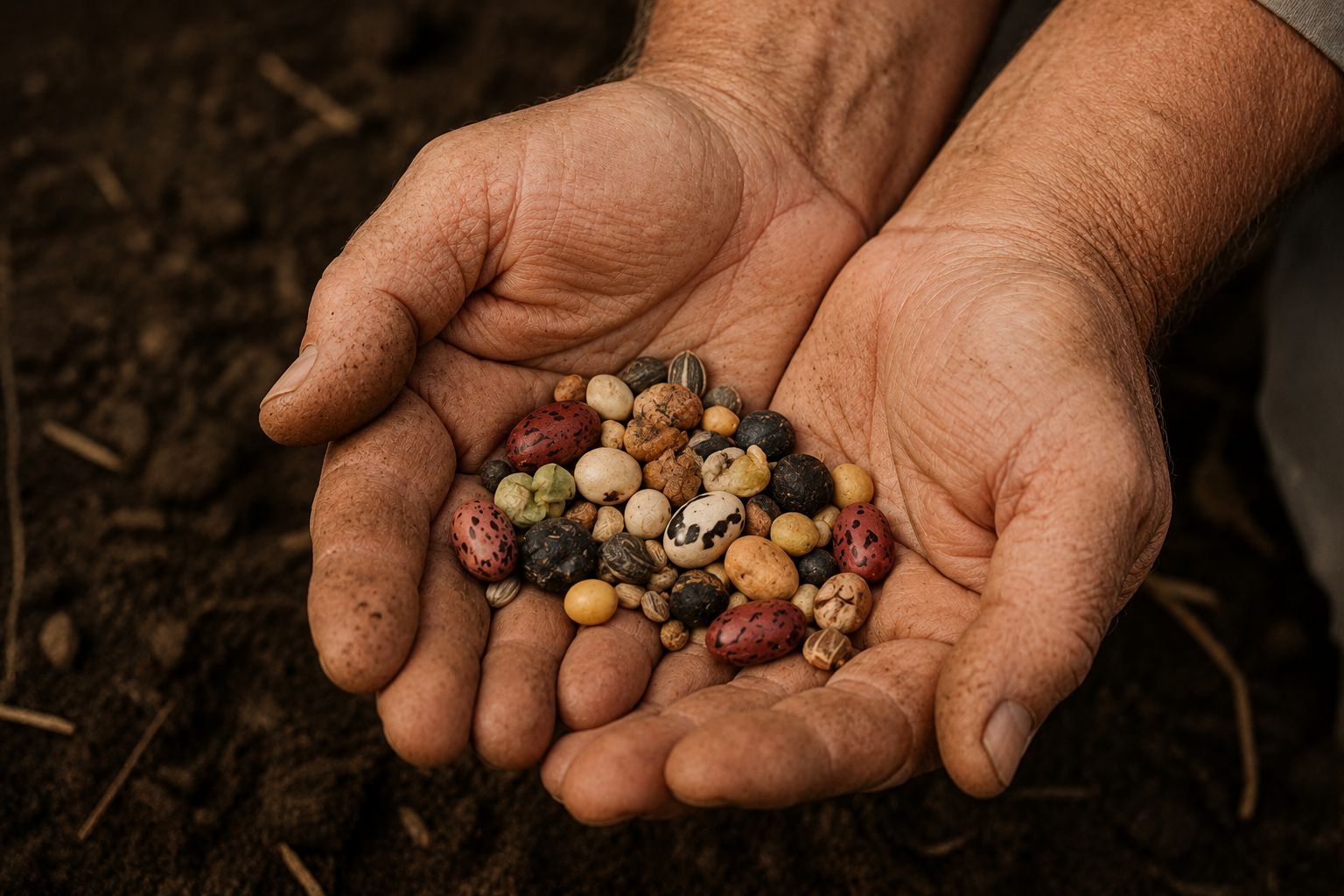
The seedless watermelon on your plate and the corporate consolidation of the global seed market are not separate stories. They are the same logic at different scales.
At the scale of a single fruit: remove the seed, make it convenient, sell more of it.
At the scale of an industry: control the seed, patent the trait, make farmers dependent, profit indefinitely.
When a home gardener buys a seedless watermelon from a supermarket and tries to save seeds to grow next year, there are no seeds to save. When a small farmer tries to source non-patented varieties to maintain independence, they find an increasingly narrow range of options.
The International Institute for Sustainable Development noted in its assessment of the Bayer-Monsanto merger that shrinking seed diversity threatens biodiversity critical for enabling plants to withstand diseases, pests, and climate change.
That dependency was not inevitable. It was built — policy by policy, merger by merger, patent by patent — by a small number of corporations that understood, long before most consumers did, that whoever controls the seed controls the food.
The Numbers Behind the Consolidation
Bayer and DowDuPont — now Corteva — controlled 75 to 80 percent of the US corn and soybean markets by 2018. Roughly 95 percent of all corn and soybeans planted in the United States are genetically engineered, with the top companies responsible for most of those sales.
In the EU, a 2017 legal study concluded that competition law should have required the blockage of the Bayer-Monsanto merger, citing high market concentration, entrenched market power, and the ability to engage in price increases across both seeds and chemicals.
The merger proceeded.
Farm Action describes the current situation directly: the result is a food system where the most basic input — the seed — is controlled not by the farmers who plant it, but by corporations that profit from keeping them dependent.
What Is Being Lost
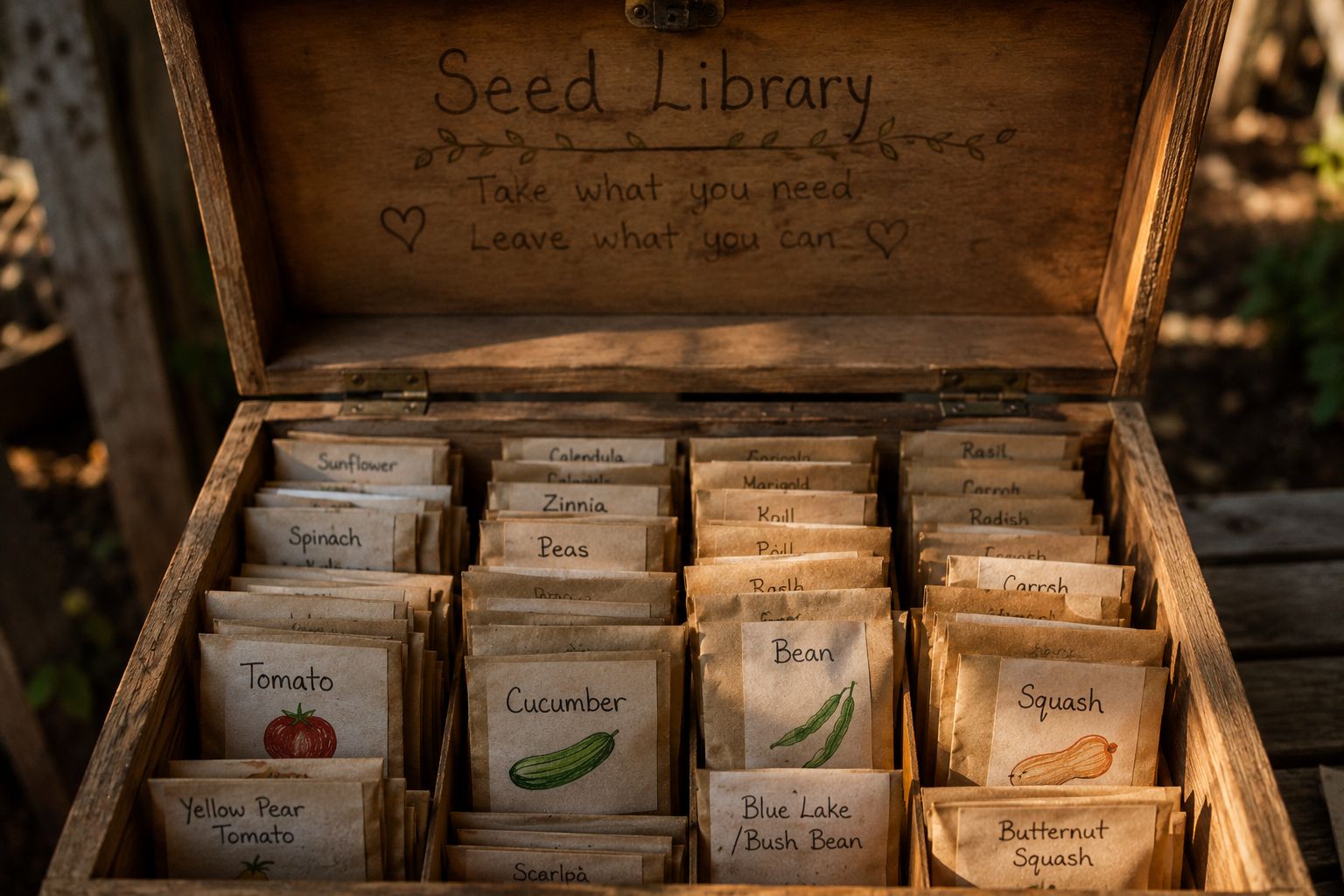
The FAO estimates that 75 percent of the world's crop diversity was lost during the twentieth century. In the United States, approximately 93 percent of vegetable seed varieties that existed
in 1903 are no longer available. The tomato varieties available in 1903 numbered in the hundreds. Most supermarkets today offer two or three.
This is not about sentiment. It is about the genetic toolkit available to humanity for adapting food crops to changing conditions. Every variety that disappears takes accumulated adaptations — to drought, heat, specific pathogens — with it. Permanently.
The Case for Seeded
The argument is not that seedless fruits are poisonous. The convenience is genuine. The biology of parthenocarpy is real.
The argument is structural. A food system built around plants that cannot reproduce requires corporate mediation at every step. Seeds must be purchased. Varieties must be licensed. None of them — the farmer, the home grower, the community garden — can close the loop without going back to the corporation that holds the patent.
The person who grows a tomato from a saved seed, plants a chilli from fruit bought at a market, or propagates a herb from a cutting is doing something that has been made deliberately harder over the past fifty years. Not illegal in most cases. Just inconvenient, less available, less visible than the alternative being sold to them at every supermarket.
It is worth knowing that. And worth deciding what to do about it.
What Seedless Actually Means — The Biology
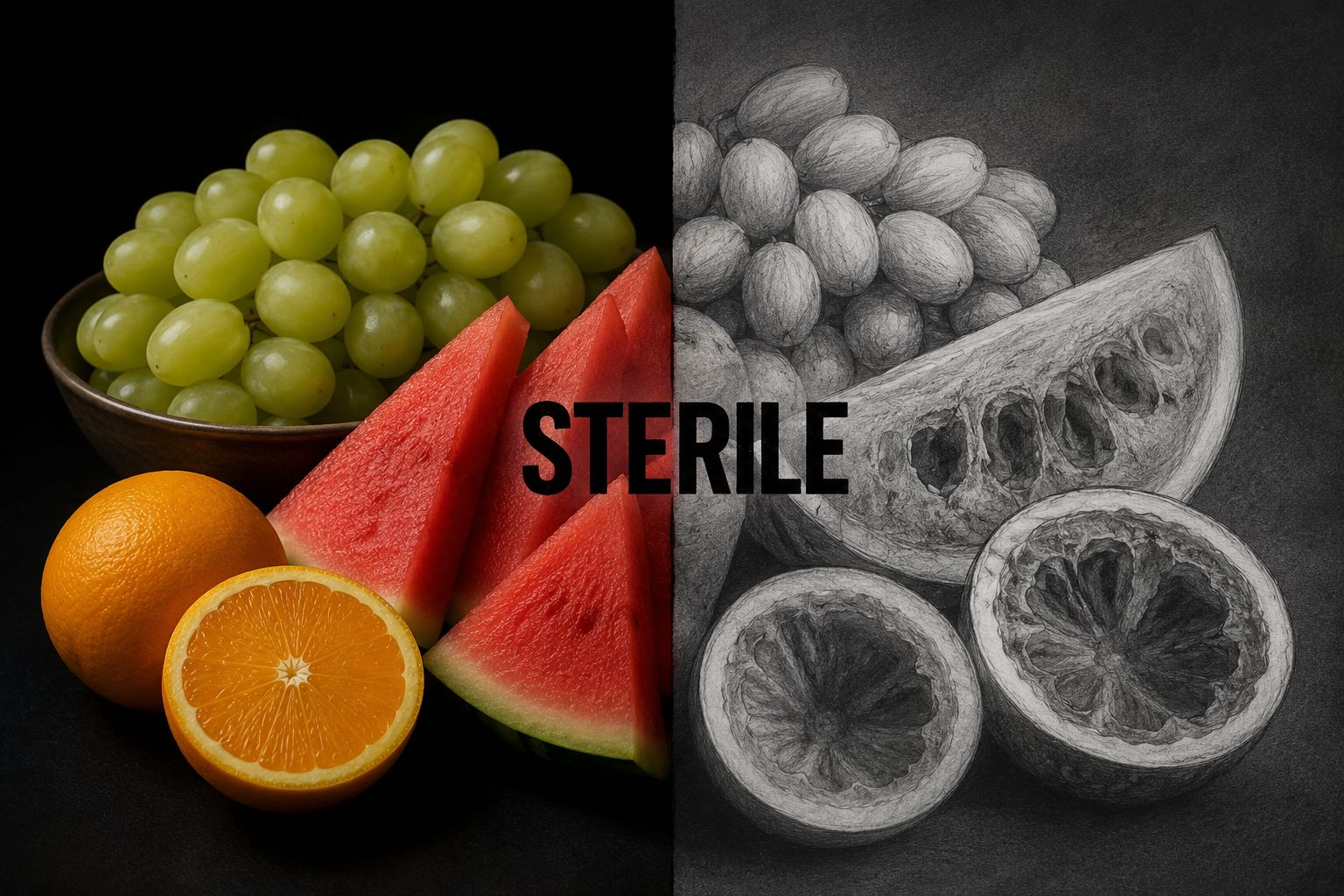
A seedless fruit is a fruit that cannot reproduce. That is not a metaphor. It is the biology. Fruits exist to carry seeds. The seed is the point. The fruit is the packaging.
Seedless fruits are produced through parthenocarpy — fruit develops without fertilisation — or stenospermocarpy — pollination occurs but the embryo aborts before a mature seed forms. Triploid plants like seedless watermelons are given three sets of chromosomes, disrupting the process that would produce viable seeds.
Michigan State University states it plainly: seedlessness to the plant is useless, since it fails to produce offspring.
And the Cavendish banana — the most consumed fruit on earth — is the clearest warning of where this leads. Every Cavendish is genetically identical. When a new strain of Panama disease called Tropical Race 4 began spreading through plantations across Asia, Australia, Africa, and Latin America, the Cavendish had no natural resistance variation to draw on. Because it can only be cloned, it cannot be bred to adapt. The same property that made it convenient to produce made it impossible to protect.
The FAO has documented this as an active, ongoing threat. Not a hypothetical. A consequence — of building a food supply around plants that nature would have allowed to die.
By Seedora Store — Trend Decode Series.
Sources: Michigan State University Extension; Wikipedia, Seedless Fruit; FAO, crop diversity loss; Corporate Europe Observatory 2022; CBAN; IISD, Bayer-Monsanto analysis; Center for Food Safety; Non-GMO Project; Farm Action 2025; YourStory 2025.