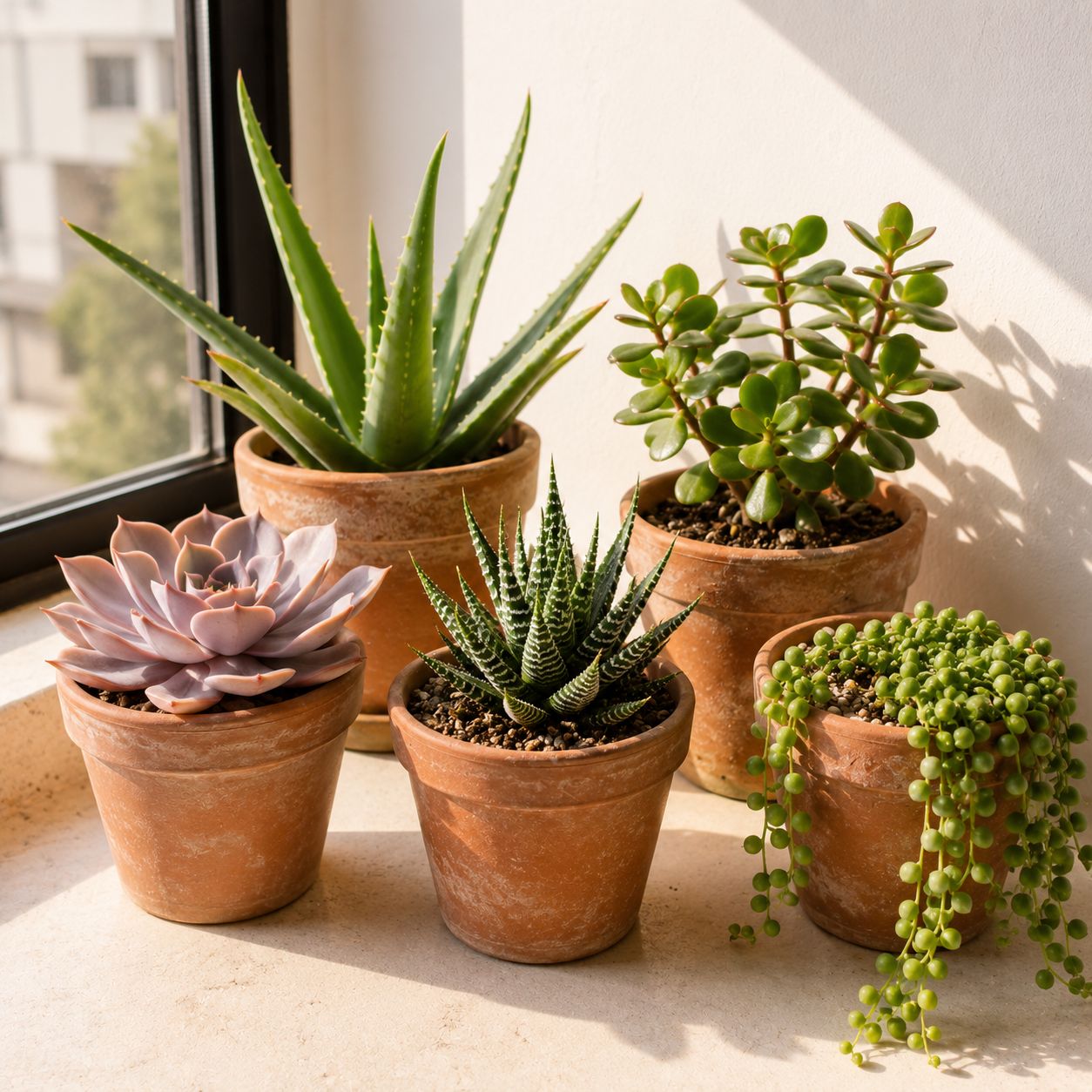
Walk into any plant shop, nursery, or even a supermarket in Pakistan right now and you will find succulents on display. Small, geometric, otherworldly-looking things in tiny terracotta pots — rosette-shaped echeverias in dusty lilac and sage green, spiked haworthias with white zebra stripes, plump jade plants that look like miniature trees. They have become one of the most popular houseplants in the world.
They are sold with a reputation that is mostly deserved. Succulents are genuinely more forgiving than most plants. They store water in their thick, fleshy leaves and stems — a survival adaptation from their native desert and semi-arid habitats. They tolerate dry indoor air that kills most houseplants. They go weeks between waterings without complaint. They are beautiful, collectible, and compact enough to fit anywhere.
But there is one thing that almost every beginner gets wrong — and it is the reason so many succulents slowly deteriorate and stretch into sad, pale shadows of what they looked like in the shop. It is not watering. It is light.
The honest version of the succulent story: succulents are easy to keep alive but moderately challenging to grow well indoors.Fix the light issue first, understand the soak-and-dry watering method, use the right soil, and the rest is genuinely simple.
This guide covers everything you need to get it right.
What Are Succulents? The One-Minute Explanation
Succulents are plants with fleshy, thickened leaves and/or swollen stems that store water. The word "succulent" comes from the Latin word sucus, meaning juice or sap. Succulents are able to survive on limited water resources, such as dew and mist, making them tolerant of drought.
While all cacti are succulents, not all succulents are cacti.The succulent category is enormous — it includes hundreds of species across dozens of plant families. What they all share is that water-storage adaptation, which is why they all thrive in the same basic conditions and why you can grow many different types together in the same pot or dish garden.
Strong, distinct leaf shapes give succulents striking textures that transform them into living sculptures for interior rooms. They make great indoor plants because they are adapted to survive dry conditions. In winter especially, homes offer dry interior air to houseplants, which is why many do not survive. Low relative humidity is not a houseplant's friend — but succulents, with their water-storing ways, endure dry air without ugly side effects.
Which Succulents Should You Grow Indoors?
Not every succulent does equally well indoors. Some varieties need intense full sun — the kind only an outdoor setting provides. Others genuinely adapt to indoor light levels. Starting with the right variety makes everything significantly easier.
| Succulent | Appearance | Light Needs | Why It Is Great for Pakistan Indoors |
|---|---|---|---|
| Echeveria | Rosette, plump leaves, dusty blue-green-pink | Bright indirect | Most popular succulent — stunning colours, compact, easy |
| Haworthia | Small, dark green, white horizontal stripes | Low to moderate | Best for lower-light rooms — truly tolerates shade |
| Aloe Vera | Long spiky green leaves, medicinal gel inside | Bright indirect to some direct | Functional and beautiful — gel treats burns and skin |
| Jade Plant (Crassula ovata) | Round glossy leaves, tree-like shape | Bright indirect | Long-lived, easy, grows into a stunning desktop tree |
| Snake Plant (Dracaena trifasciata) | Upright sword leaves, yellow edges | Low to bright | Covered in our Indoor Plants #01 — the ultimate beginner plant |
| String of Pearls | Trailing, bead-like round leaves | Bright indirect | Stunning in hanging pots or trailing over shelves |
| Zebra Plant (Haworthiopsis) | Small, spiky, white-striped | Low to moderate | Compact, very tolerant, great for desks and shelves |
| Panda Plant (Kalanchoe tomentosa) | Fuzzy grey-green, rust-tipped leaves | Bright indirect | Unusual texture — soft and touchable, very slow-growing |
💡 For absolute beginners in Pakistani apartments, start with Haworthia or Jade Plant. Both genuinely tolerate indoor light conditions without stretching. Echeveria is the most beautiful but needs the brightest window you have. Aloe vera is the most useful. Pick based on what you have to offer in terms of light.
Step 01 — Getting Light Right (The Most Important Thing)
This is where most indoor succulent growing goes wrong — and why most guides do you a disservice by glossing over it.
Succulents evolved in some of the brightest, most exposed environments on earth. Outdoors in their native habitats, succulents receive full sun — 6, 8, 10 or more hours of direct sunlight per day. Indoors, even a bright south-facing windowsill typically delivers a fraction of that intensity. Light levels drop dramatically as you move away from windows: a plant 3 feet back from a window may receive only 10–20% of the light available right at the glass.
What happens without enough light:
The result of insufficient light is called etiolation: the plant stretches toward the light source, producing progressively longer stem internodes, smaller and more spaced-out leaves, and a pale, washed-out colour.The tight, compact rosette of an echeveria you bought begins to look like a loose, elongated tower reaching toward the window. The colours fade. The leaves space out. The plant looks nothing like it did at the shop.
The right placement:
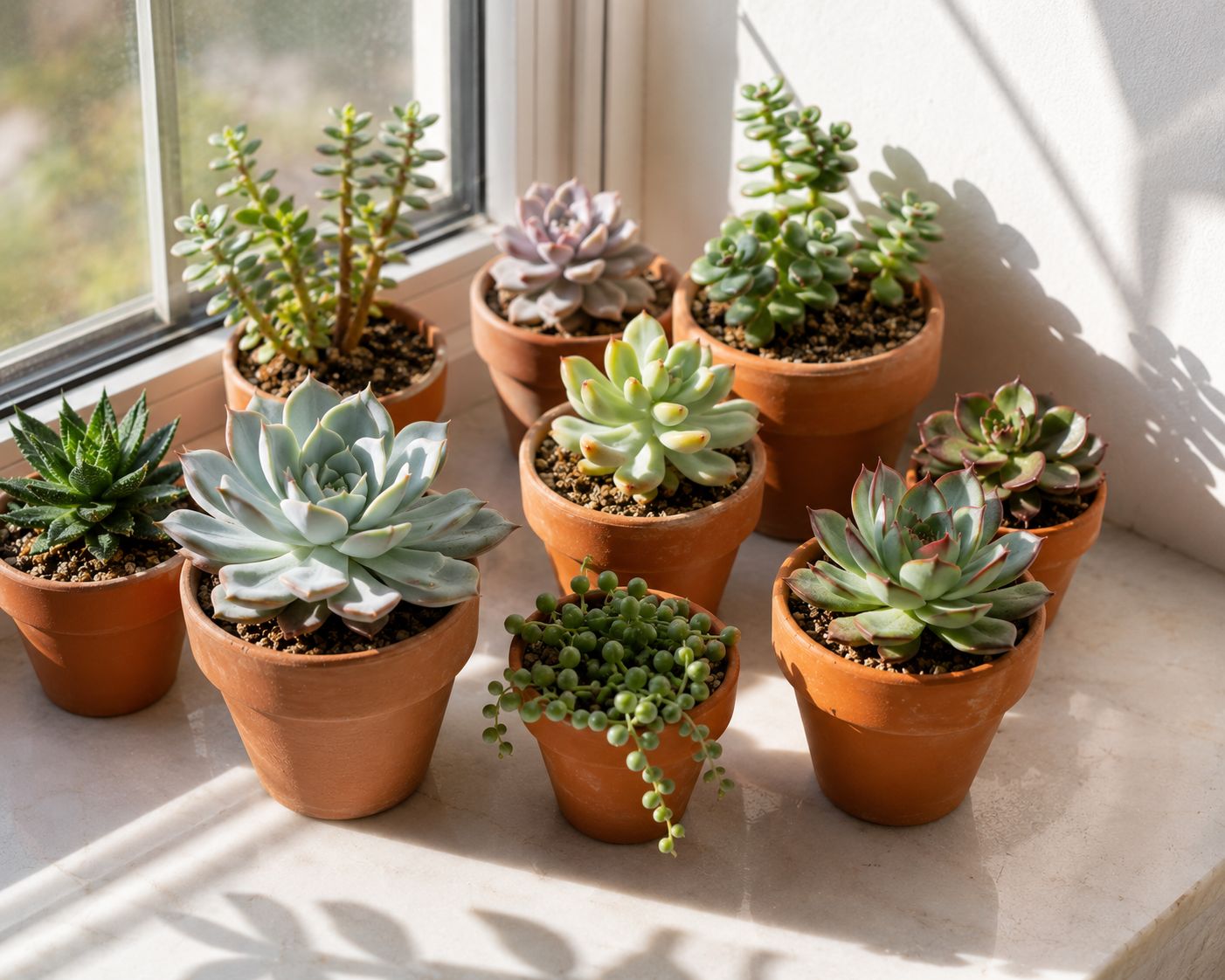
South-facing windows are ideal. Aim for about six hours of sunlight each day.In Pakistani apartments, a south or west-facing windowsill that gets unobstructed morning or afternoon sun is the sweet spot. Place the pot directly on the windowsill — not on a table near the window, not on a shelf a few feet away. Right at the glass.
Rotate plants to prevent lopsided growth.Turn your succulent pot a quarter turn every week or two so all sides receive equal sun exposure. A plant lit from only one direction grows toward that direction and becomes increasingly one-sided.
When natural light is not enough:
A grow light set to 12–16 hours per day, positioned 6–12 inches above the plants, can fully replace natural light and is the most reliable method for indoor succulent growing in low-light homes or in winter. More light solves most succulent problems — no amount of perfect watering or feeding compensates for inadequate light.
💡 The honest reality for Pakistani apartments: Many urban apartments in Karachi, Lahore, and Islamabad face inward, have limited window exposure, or are shaded by neighbouring buildings. If your windows do not get direct sun for at least four to six hours, choose shade-tolerant varieties like Haworthia and Zebra Plant, or invest in a small LED grow light for a few hundred rupees.
Step 02 — The Soak-and-Dry Watering Method
Overwatering is the most common cause of succulent death. But the solution is not watering very little — it is watering correctly using a specific method.
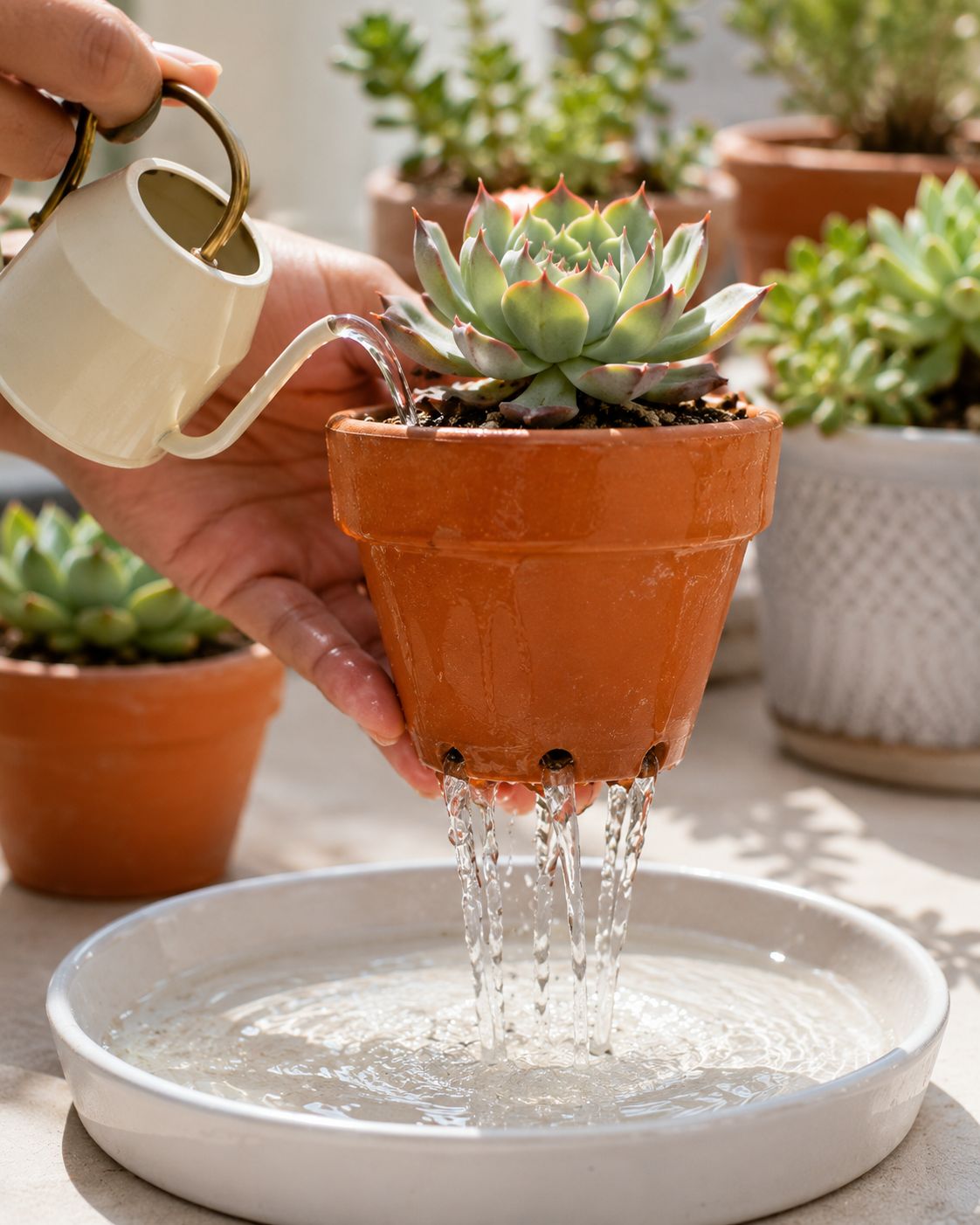
The correct approach to watering succulents is the opposite of what most houseplant advice recommends. The method is called soak-and-dry: water thoroughly until water flows freely from the drainage holes, then wait until the soil is completely dry before watering again.
In practice, this means:
Step 1 — Soak. When it is time to water, water generously. Pour water slowly and evenly over the soil until you see water flowing freely from the drainage hole at the bottom. This ensures the entire root ball is thoroughly wet and the roots actually access the moisture.
Step 2 — Drain. Let the pot drain completely.Never allow water to sit in saucers or outer sleeves.If your decorative pot has no drainage and you are using an inner nursery pot, lift it out after watering, let it drain fully over a sink, and then replace it. Standing water at the base of the pot is how roots rot.
Step 3 — Wait until completely dry. Before watering again, test the soil by inserting a finger or skewer two to three inches deep.Only water after the soil is completely dry and the leaves show slight wrinkles or feel less firm.If there is any moisture, wait.
How often does that mean?
| Season / Conditions | Approximate Frequency |
|---|---|
| Pakistani summer — bright light, warm | Every 10–14 days |
| Pakistani winter — cool, slower growth | Every 3–5 weeks |
| Low light conditions | Every 3–6 weeks |
| Very bright, hot, terracotta pot | Every 7–10 days |
These are guides, not schedules. The soil test is always the real answer.
Two important things never to do:
Avoid misting, as this promotes shallow root systems and fungal growth.Misting the leaves — which social media often shows as a way to water succulents — actually does more harm than good. Water the soil, not the plant.
Pour water directly into the soil, not on the leaves.Wet leaves, especially in humid Pakistani monsoon conditions, invite fungal problems and rot at the leaf base.
⚠️ Signs of overwatering: If leaves yellow and stems become soft and weak, conditions may be too wet.Soft, mushy leaves at the base of the plant and a foul smell from the soil are the clearest signs root rot has begun. Act immediately — stop watering, let the soil dry completely, and check the roots.
💧 Signs of underwatering: If lower leaves are becoming wrinkled or drying up, conditions are too dry.Slightly wrinkled or puckered leaves that feel less firm than usual are the plant telling you it is ready for water.
Step 03 — Soil and Pot: Get These Right Once
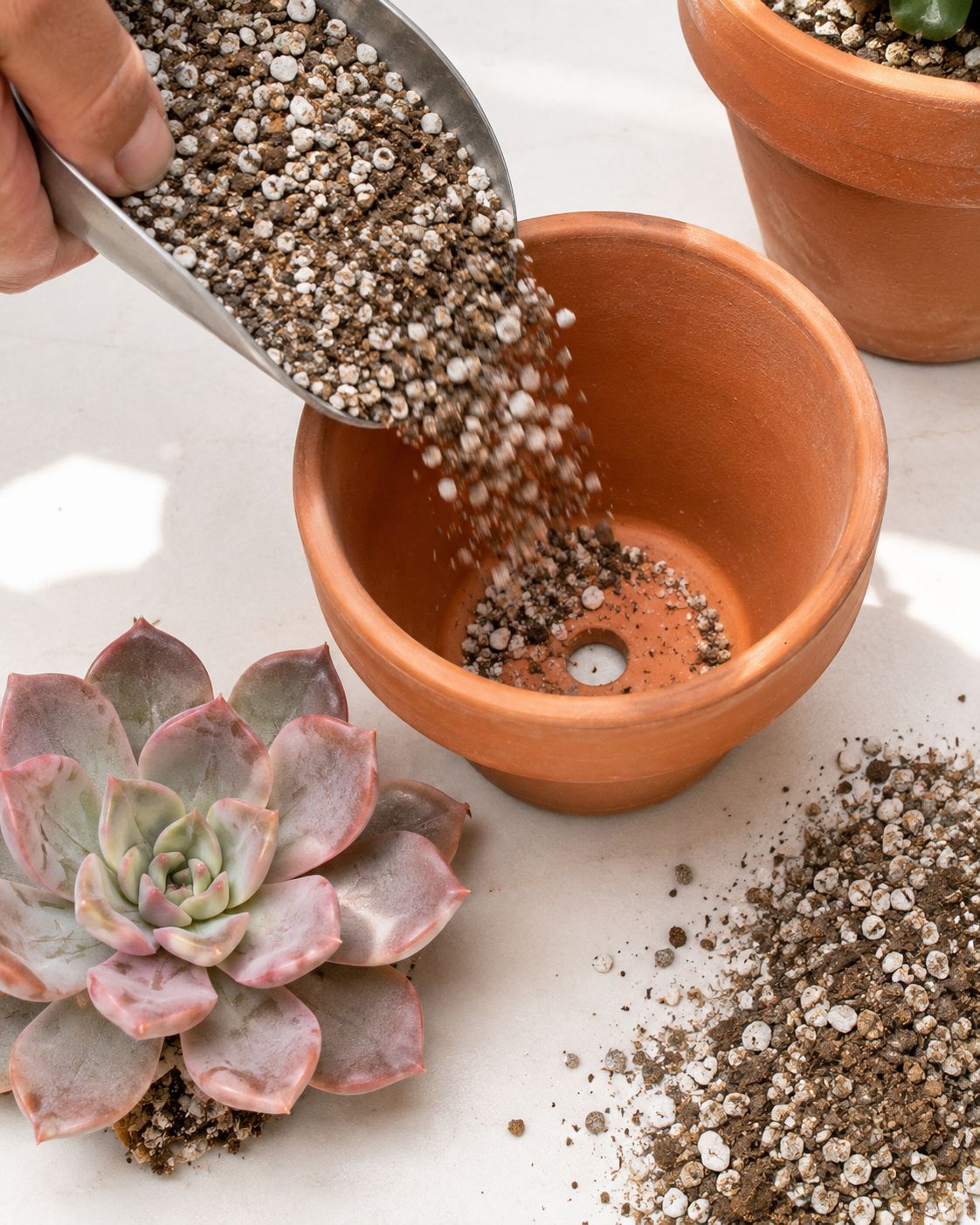
Soil and pot choice are a one-time setup decision that affects everything about how easy your succulent is to keep alive.
Soil:
Provide a very well-draining potting medium. Nurseries always plant their succulents in soil that is too rich and retains too much moisture, so you will want to repot your succulent as soon as you bring it home. Start with a coarse potting mix with good drainage and aeration.
Standard potting soil holds far too much water for succulents. The mix you want is gritty, fast-draining, and dries out quickly after watering. Two options:
- Buy: Cactus and succulent potting mix — available at most nurseries. This is the easiest option.
- DIY: Mix 50% regular potting soil with 50% coarse sand or perlite.To test how well the mixture drains, wet it, then squeeze it in your hand. If water streams out, it is too wet. Good succulent mix should hold its shape briefly, then crumble apart.
One thing to specifically avoid: Do not layer rocks at the bottom of the pot. It raises the water table and increases the risk of rot.This is a popular Pinterest tip that actually makes drainage worse, not better.
Pot:
Always use pots with drainage holes — ideally terracotta, which dries faster than plastic.
Terracotta is the ideal material for succulents in Pakistani conditions. It is porous — it wicks moisture through the walls — and it breathes, allowing roots to dry faster between waterings. In Pakistan's warm climate, terracotta prevents the moisture retention that kills succulents more than almost anything else.
When choosing a pot, make sure it complements the size of your succulent. An oversized pot traps too much water, risking root rot. One that is too small may stunt the plant's growth.The right pot is roughly the same width as the widest part of the plant — just enough room for the roots with a small amount of space to grow.
Most houseplant indoor succulent plants have shallow roots, so you can tuck them into shallow bowls or squat pots.This is part of what makes succulents so versatile — they work in dishes, teacups, wide shallow bowls, and small decorative containers, as long as drainage is handled.
Step 04 — Temperature, Humidity, and Air
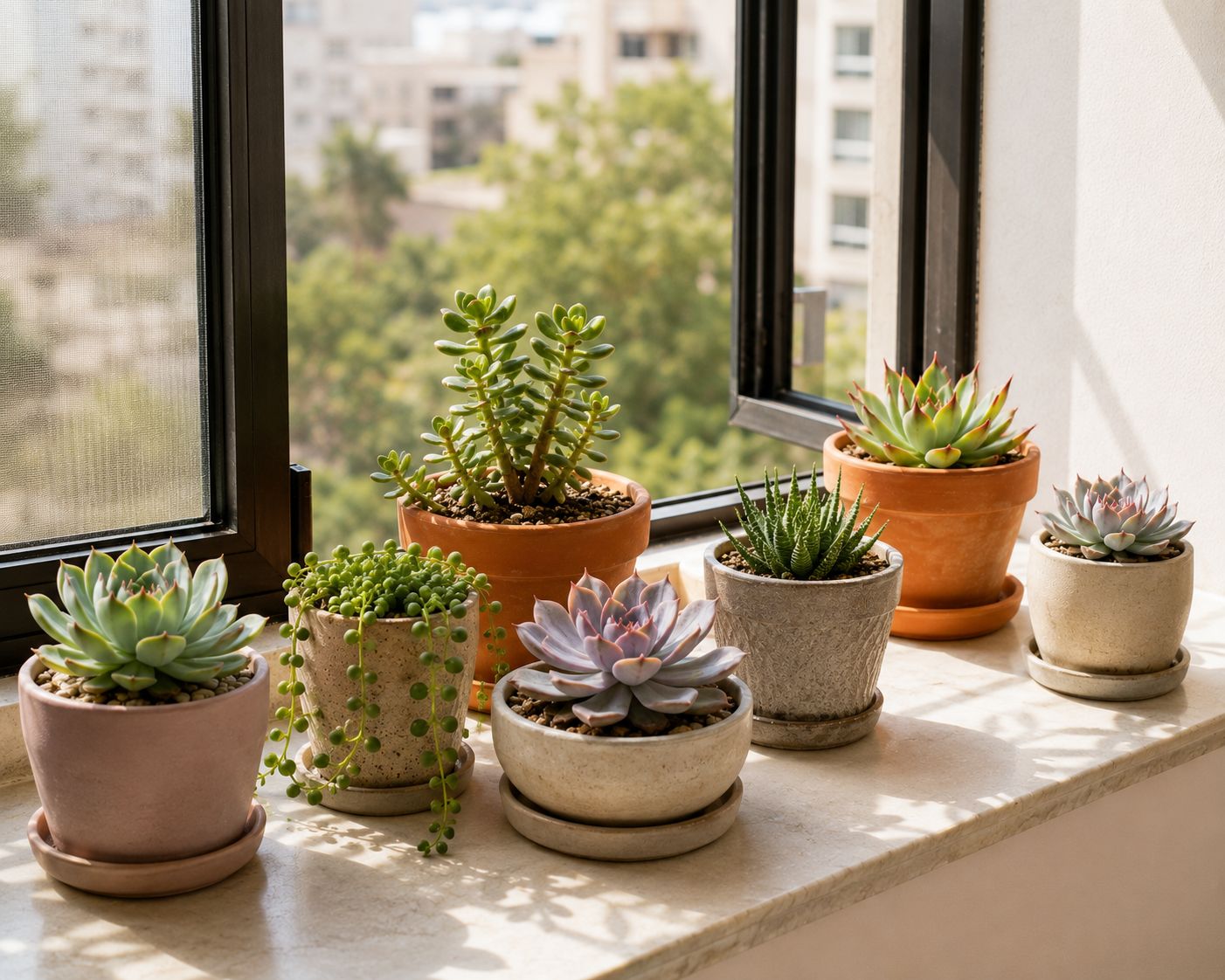
Pakistani indoor conditions are actually quite well-suited to succulents in most seasons — with one exception worth knowing.
Temperature:
Succulents prefer temperatures between 21–27°C during active growth. Most are sensitive to cold below 10°C. Indoors, avoid drafts from air conditioners or heaters.
Pakistani summers — 25 to 35°C — are comfortable for most succulents. Pakistani winters — 5 to 15°C in northern cities — require moving succulents away from cold windowsills, especially single-glazed windows where temperatures at the glass can drop significantly at night. A few degrees of cold does not kill most succulents, but frost certainly does.
Humidity:
Keep humidity below 50%. Excess humidity can lead to mould or soft, mushy foliage.Pakistani monsoon season — July to September — brings high humidity that is genuinely stressful for succulents. During this period, improve air circulation around your plants, water even less frequently than usual, and avoid having leaves rest against each other where trapped moisture can cause rot.
Air circulation:
Good airflow between plants prevents the humid, stagnant conditions that invite fungal disease and pests. If your plants are grouped together on a windowsill, space them apart slightly. Opening windows regularly in the morning and evening during cooler months keeps air moving and benefits the plants significantly.
Step 05 — Feeding
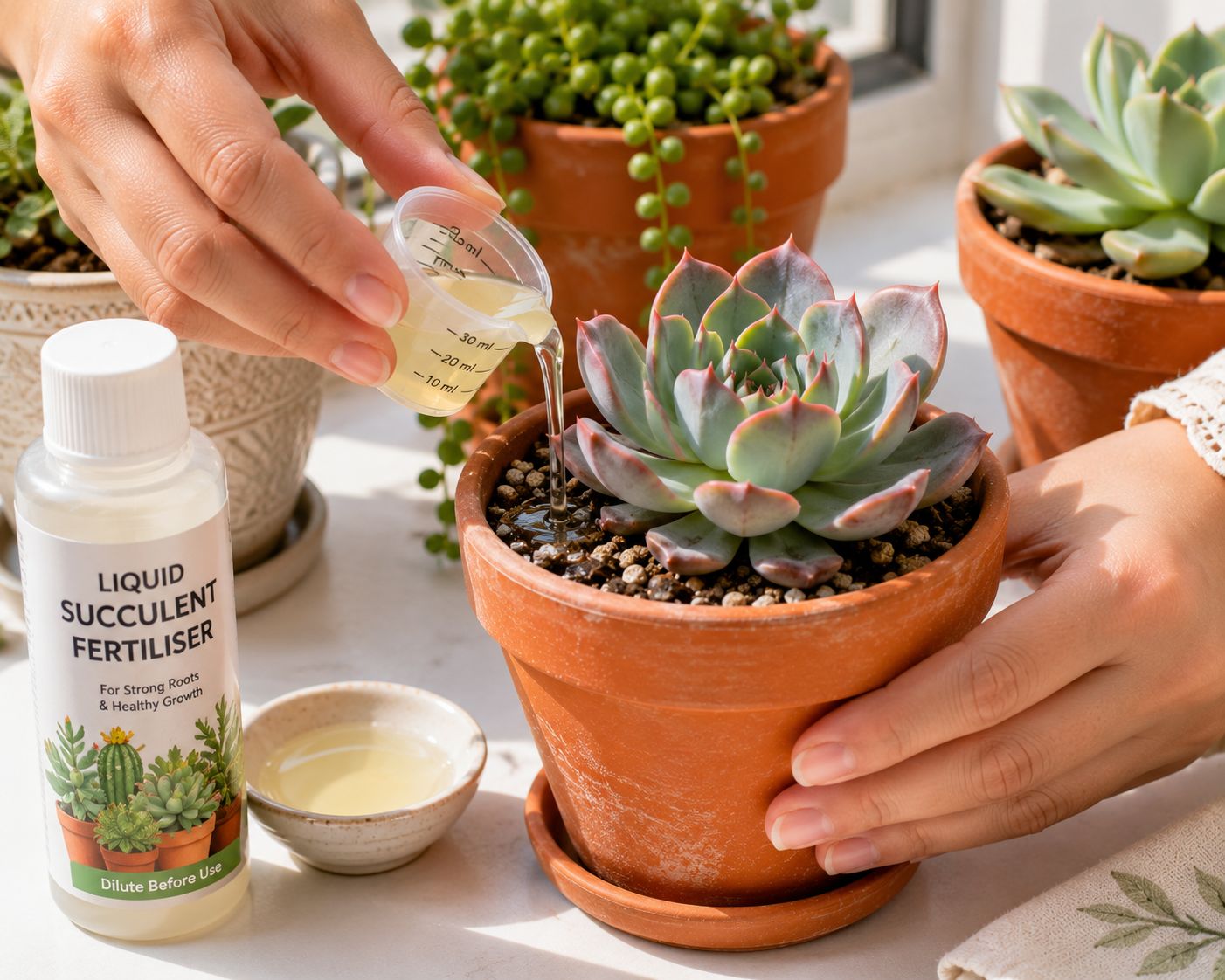
Succulents are genuinely light feeders — they evolved in nutrient-poor soils and can sustain themselves without much fertilisation. But a small, well-timed feed during the growing season produces noticeably healthier, better-coloured plants.
If you want to encourage growth, apply a balanced fertiliser (10-10-10), diluted with water to half-strength, up to once a month during the growing season — spring and summer. Avoid over-fertilising, which may cause elongated, weak growth. Suspend feeding during autumn and winter dormancy.
Feed succulents every three months, ideally using a liquid cactus fertiliser. Make sure the compost is moist at the time of application.Never apply fertiliser to dry soil — it concentrates at the root zone and can cause fertiliser burn.
The simplest schedule for Pakistani conditions: feed once in February when growth begins, once in May, once in August, and nothing from October through January. Four feeds per year, at half the recommended strength, is plenty.
Step 06 — Propagation: One Becomes Many
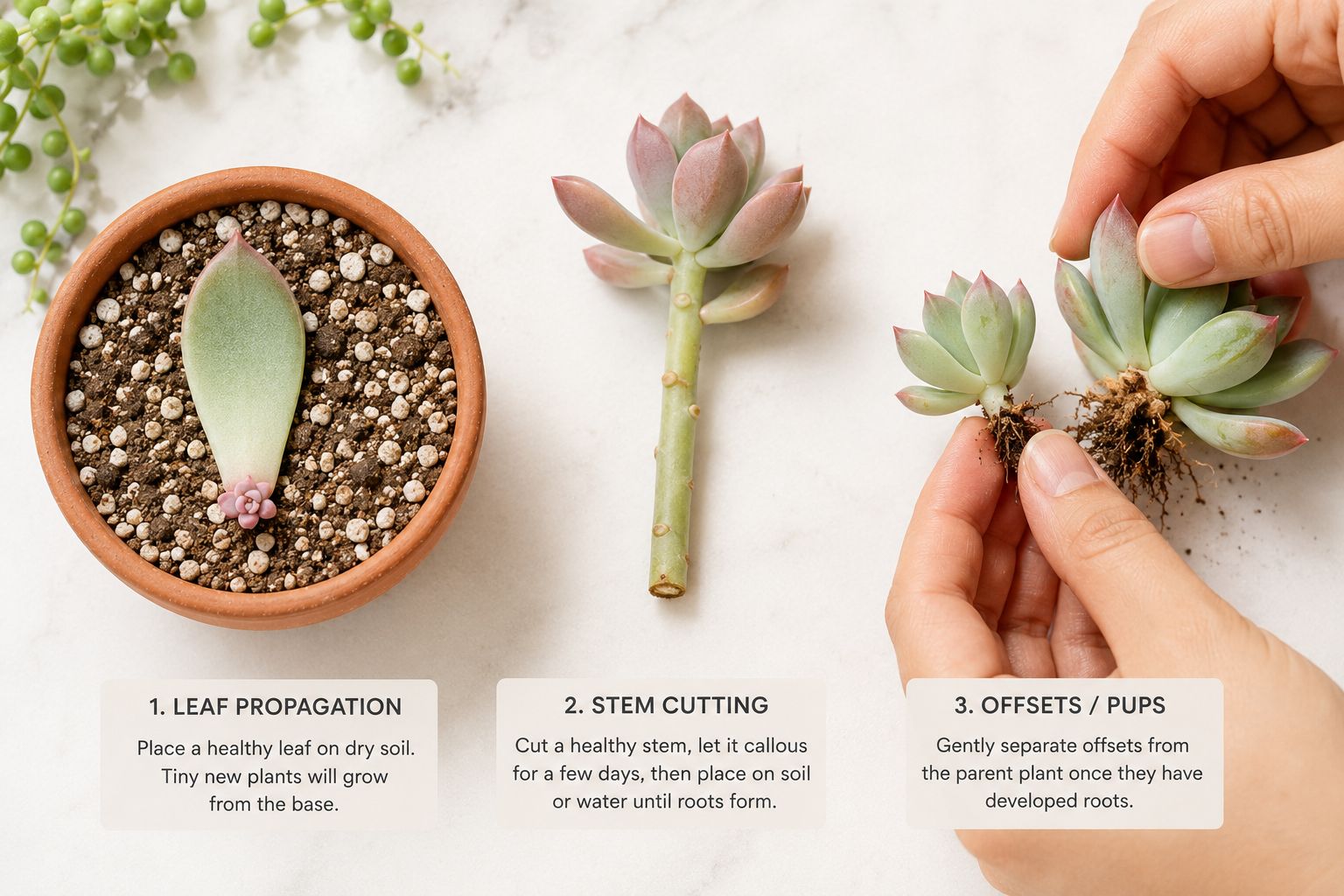
Succulents are among the most generous propagators in the plant world. A single plant can produce dozens of new ones through multiple methods — all of them achievable at home with no special equipment.
Method 1 — Leaf Propagation (Most Satisfying)
This method works best with echeverias, sedums, and most rosette-shaped succulents.
Gently twist a healthy, plump, undamaged leaf away from the stem — the whole leaf must come off cleanly with the base intact. A leaf that breaks off partway does not root. Lay the leaves on top of dry cactus mix — not buried, just resting on the surface. Place in bright indirect light. Mist very lightly every few days.
Within two to four weeks, tiny pink roots emerge from the base of the leaf. A few weeks later, a miniature rosette appears. Eventually the original leaf shrivels as the new plant draws from it — this is normal, leave it alone until it falls off naturally. The new succulent is ready to pot individually once it has several leaves of its own.
Method 2 — Stem Cutting (Fastest Results)
This works for any succulent with a visible stem — jade plants, echeverias that have stretched, aeoniums, sedums, and many others.
Prune the top quarter of the stem using a clean pair of scissors. Sit the stem cutting on a dry tissue for around two days to callous its wound — a sunless windowsill is the perfect location for this period. Fill a small pot with cactus and succulent potting mix and use your finger to push a hole, then place the calloused end of the cutting into it.
Water lightly after a week. Roots develop over two to six weeks depending on the variety and conditions. Spring and early summer produce the fastest root development.
Method 3 — Offsets / Pups (Easiest)
Many succulents — aloe vera, haworthia, echeveria, and most clustering varieties — produce small offsets or pups around the base of the parent plant.Over time, aloe vera produces more clusters of leaves called offsets that can form a colony large enough to fill the whole container.
When offsets are large enough to handle — typically when they have their own visible root system and are at least a quarter the size of the parent — gently separate them with a clean knife and pot individually into fresh cactus mix. These are the fastest to establish because they already have their own roots.
🌱 Important note on leaf propagation: Some succulents — particularly haworthia and gasteria — do not propagate reliably from leaves. Stick to offset separation or stem cuttings for these varieties.
Repotting — When and How
It is beneficial to repot your succulents every couple of years to refresh the soil and check the health of the roots.
Signs your succulent needs repotting: roots growing through drainage holes, the plant lifting itself out of the pot as roots fill the space, or visible decline despite good care. The best time to repot is spring, when the plant is entering active growth.
Always repot into a container just one size larger — too large a pot holds too much soil and moisture, which leads to root rot. Use fresh cactus mix. After repotting, wait one week before watering to allow any disturbed roots to settle and minor root damage to heal.
Always remove your new succulent from its nursery pot and repot into a better-draining mix as soon as you bring it home. This single step — immediately repotting from the dense, moisture-retentive nursery soil into a gritty cactus mix — prevents the majority of beginner succulent failures.
Creating a Succulent Dish Garden
One of the most beautiful and unique things about succulents is that multiple varieties can be grown together in a single container. You can combine several in the same container to create a dish garden. The secret to success lies in plant selection — be sure you are mixing and matching plants with similar growth rates and care requirements.
Choose varieties with matching light and water needs. Combine different textures — a flat rosette echeveria beside a spiky haworthia beside a trailing sedum. Use a wide, shallow dish with drainage holes. Fill with cactus mix and arrange plants close together but not touching — packed tight looks beautiful immediately and fills in naturally over time.
Dish gardens make exceptional gifts, desk decorations, and coffee table centrepieces. They require care for one whole collection with a single watering.
Common Problems and Fixes
| Problem | Cause | Fix |
|---|---|---|
| Stretching, pale, spaced-out leaves (etiolation) | Not enough light | Move to brightest available spot or add grow light |
| Soft, mushy leaves and base | Overwatering / root rot | Stop watering immediately. Check roots. Repot in dry, fresh cactus mix |
| Wrinkled, puckered leaves | Underwatering | Water thoroughly using soak-and-dry method |
| Brown, crispy leaf tips | Too much direct harsh sun or dry hot air | Move away from intense afternoon sun, improve humidity slightly |
| Lower leaves yellowing and drying | Normal ageing | Keep yellowing leaves on the plant until they naturally drop off — the plant may be taking nutrients from that leaf for new growth |
| White cotton-like fluff on leaves | Mealybugs | Spray with rubbing alcohol and pour alcohol over the soil to kill any eggs |
| Tiny flies around soil | Fungus gnats from overwatering | Let soil dry completely between waterings |
| Plant leaning to one side | One-directional light | Rotate pot 90° every week |
| Pale colour, slow growth in winter | Winter dormancy | Normal — reduce watering and stop feeding until spring |
Quick Care Summary
| Care | Requirement |
|---|---|
| ☀️ Sunlight | Bright indirect — 6 hours minimum, south/west window |
| 💧 Watering | Soak-and-dry — only when soil is completely dry |
| 🌡️ Temperature | 21–27°C ideal — keep above 10°C |
| 🪴 Pot | Terracotta with drainage holes — right-sized, never oversized |
| 🌱 Soil | Cactus/succulent mix with added perlite — repot nursery soil immediately |
| 🌿 Feeding | Half-strength balanced liquid fertiliser — once monthly, spring and summer only |
| 📅 Repotting | Every 2 years or when root-bound — go up one size only |
| ✂️ Propagation | Leaf (echeveria), stem cutting (most varieties), offsets (aloe, haworthia) |
| ☁️ Humidity | Below 50% — improve airflow during monsoon season |
⚠️ Pet and child safety: Most succulents are non-toxic when eaten, but some plants to avoid are Kalanchoe (flaming Katie) and Euphorbia (African milk tree) which can cause an upset stomach if ingested. If you have small children or pets that chew on plants, check the specific variety before displaying it within reach.
By Seedora Store — your guide to indoor plants that actually work in homes and apartments.