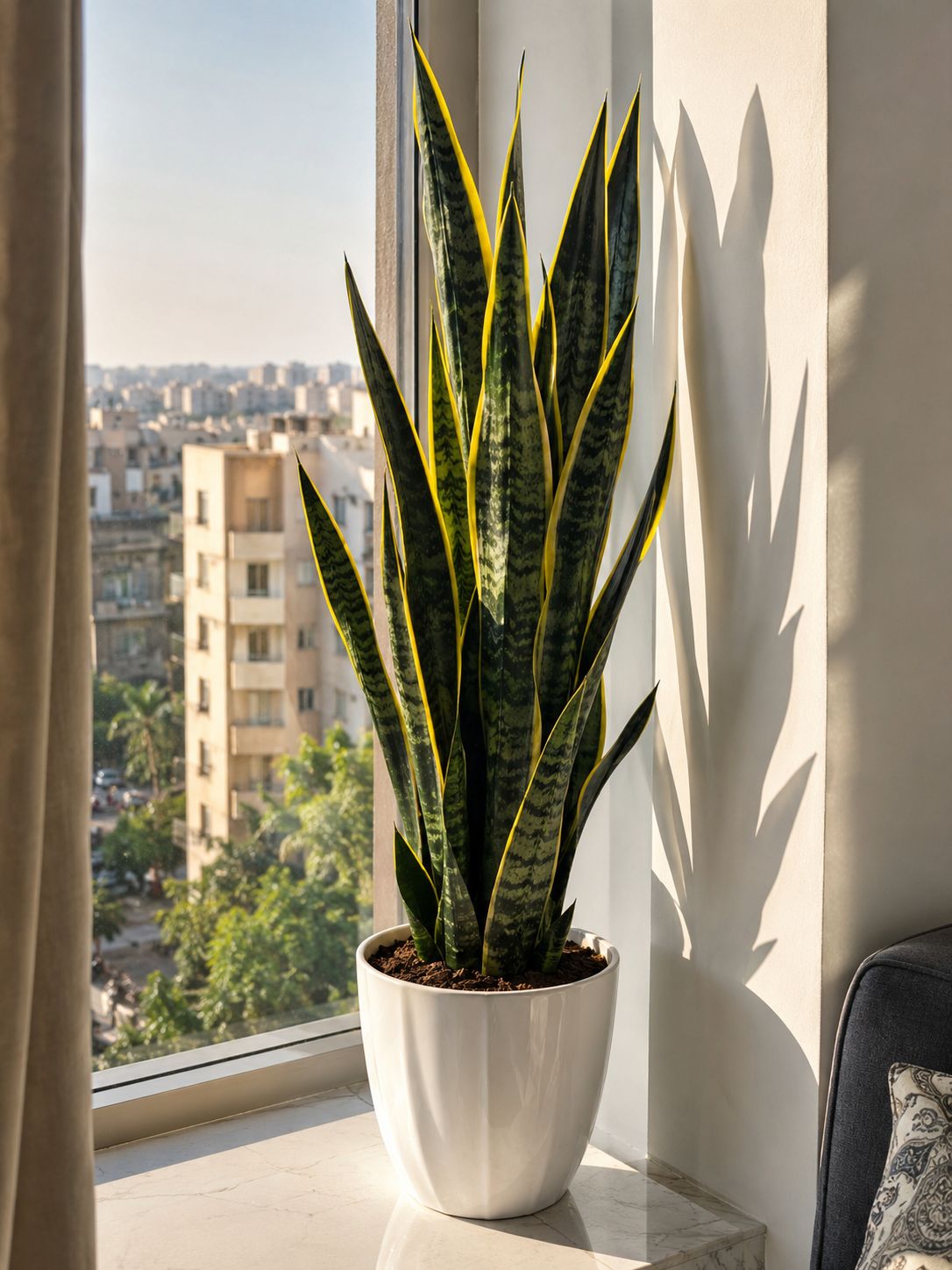
There is a plant that sits in the corner of offices that nobody waters. A plant that survives in dim hallways for months without anyone paying attention to it. A plant that gets forgotten on a holiday, ignored through a busy week, underlit in a north-facing room — and keeps going anyway, calm and upright, looking exactly the same as it did when you bought it.
That is the snake plant.
It is not dramatic about what it needs. It does not droop the moment you forget to water it like basil does. It does not reach desperately toward the window like a leggy pothos. It simply stands there, sword-like leaves pointing upward, structured and architectural, quietly doing its job.
Snake plant — also known by its botanical name Dracaena trifasciata, formerly called Sansevieria trifasciata — is consistently ranked as one of the easiest and most beginner-friendly houseplants in the world. It tolerates low light, requires very little water, adapts easily to indoor environments, and with basic care can live for many years — sometimes decades.
If you have ever killed a houseplant and felt defeated by it, start here. This plant will not let you fail.
What Is Snake Plant Called Around the World?
| Region | Local Name |
|---|---|
| 🇵🇰 Pakistan / Common | سانپ کا پودا (Saanp Ka Poda) / Snake Plant |
| 🇬🇧 British English | Mother-in-Law's Tongue |
| 🇧🇷 Brazil | Espada de São Jorge (Saint George's Sword) |
| 🇳🇬 Nigeria / West Africa | Bow String Hemp |
| 🇨🇳 Chinese | 虎尾兰 (Tiger's Tail Orchid) |
| 🇰🇷 Korean | 산세비에리아 (Sansevieria) |
| 🌐 Scientific | Dracaena trifasciata (formerly Sansevieria trifasciata) |
🌿 Snake plants are native to West Africa — specifically Nigeria and the Democratic Republic of the Congo — where they grow in dry, rocky soil and harsh, unpredictable conditions. This origin explains everything about how they behave indoors. They evolved to survive drought, poor soil, intense heat, and low light. Your apartment, however imperfect, is almost certainly more comfortable than where they came from.
Which Snake Plant Should You Get?
Snake plants come in dozens of varieties. All of them are easy to care for. The differences are mostly visual — height, leaf width, colour, and pattern.
| Variety | Appearance | Height | Best For |
|---|---|---|---|
| Laurentii (classic) | Dark green with golden yellow edges | 60–120 cm | Any room — the most common and dramatic |
| Moonshine | Silver-grey, pale green leaves | 45–60 cm | Minimal, modern interiors — very elegant |
| Hahnii / Bird's Nest | Low rosette, compact tight cluster | 10–20 cm | Desks, shelves, small spaces |
| Cylindrica | Round, pencil-like tubular leaves | 60–90 cm | Contemporary interiors, unusual look |
| Black Gold | Dark green with bright gold border | 60–90 cm | Bold statement plant, any room |
| Twisted Sister | Twisted, short, yellow-edged leaves | 15–25 cm | Quirky character plant for shelves |
💡 For most Pakistani homes, the classic Laurentii or Moonshine is the best choice. They are widely available from nurseries in Karachi, Lahore, and Islamabad, they look stunning in any interior, and they are among the most forgiving varieties of all.
Why Snake Plant Belongs in Every Pakistani Home
🏠 Survives Low Light — Most Pakistani apartments have limited natural light — rooms face inward, windows are shaded by neighbouring buildings, curtains are kept drawn. Snake plants are one of the few genuinely attractive houseplants that thrive in these conditions. They grow in low to moderate light and adapt easily to indoor environments.
💧 Needs Almost No Water — In Pakistani summers when people travel for Eid and holidays, many houseplants die from neglect. A snake plant can go two to six weeks without water in normal conditions and show no distress. It is the plant for busy households and frequent travellers.
🌬️ Genuine Air Benefits — NASA's 1989 Clean Air Study identified snake plants as effective at removing indoor air pollutants including formaldehyde, benzene, xylene, and toluene — chemicals commonly off-gassed by furniture, paint, and cleaning products. To be honest: the study was conducted in sealed chambers, and the effect in a typical ventilated room is more modest than social media suggests. But the plant does filter air to a real, measurable degree, and that is more than most decorative objects do.
🌙 Releases Oxygen at Night — Unlike most plants that produce oxygen only during daylight photosynthesis, snake plants use a special process called CAM photosynthesis that allows them to release oxygen at night. This makes them particularly well-suited for bedrooms.
😌 Psychological Wellbeing — Multiple studies confirm that having plants in living and working spaces reduces stress, lowers blood pressure, and improves mood and focus. Snake plants in particular have a long cultural history across West Africa, Brazil, and parts of Asia as plants believed to bring positive energy and protection into the home.
🎨 Architectural Beauty — Snake plants look like they were designed by an architect. The upright, structured leaves create strong vertical lines that complement minimalist, modern, and traditional Pakistani interiors equally. They are genuinely beautiful objects whether or not you care about horticulture.
🔁 Propagates Infinitely for Free — One snake plant becomes two becomes four. Division, water propagation, and leaf cuttings all work. You will never need to buy another snake plant after your first.
Step 01 — Choosing Your Plant and First Placement
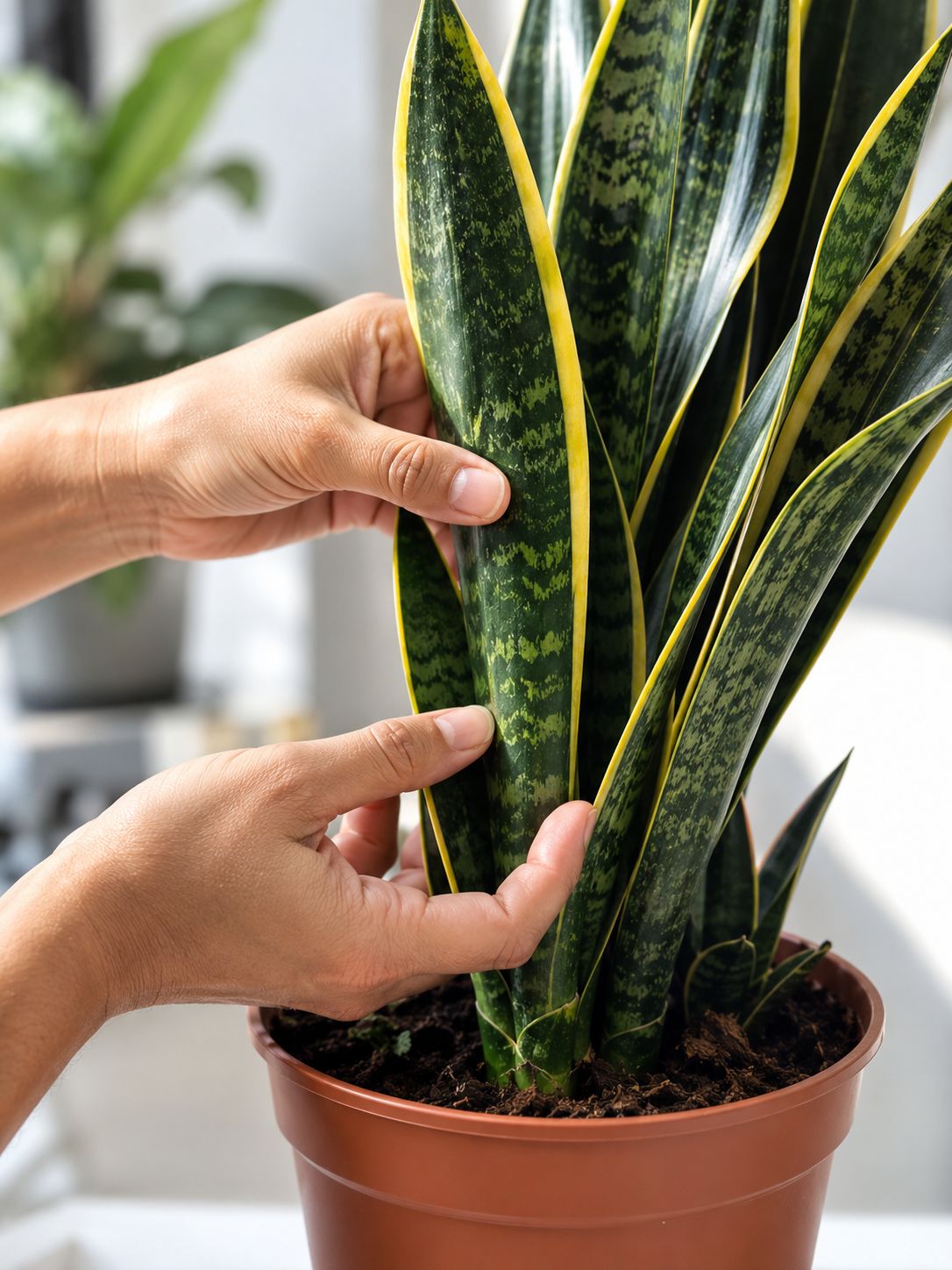
Buy your first snake plant from a nursery or reputable plant seller — look for a plant with firm, upright, undamaged leaves. Avoid plants with soft, mushy areas at the base of the leaves, yellowing lower leaves, or visible signs of pests on the undersides. A healthy snake plant feels almost rigid when you gently squeeze a leaf between your fingers.
Where to place it:
Snake plants tolerate a wide range of light conditions — this is one of their greatest strengths. But "tolerates" and "thrives" are different things.
- Bright indirect light (near a window, not in harsh direct sun) = fastest growth, best colour, most vigorous plant
- Moderate indirect light (a few metres from a window) = good growth, reliable health
- Low light (a dim corner, a north-facing room) = very slow growth, but the plant stays alive and healthy
The one condition to avoid is harsh, direct afternoon sun — particularly in Pakistani summers when afternoon sun is intense. The leaves can scorch and develop brown, crispy patches that are permanent. Morning sun is fine. A sheer curtain between the plant and an intensely sunny window filters light perfectly.
💡 The bedroom placement: Snake plants are excellent bedroom plants because of their night-time oxygen release. A medium-sized plant on a bedside table or dresser near a window is both beautiful and functional. Just keep it away from direct air conditioning airflow — cold, dry air from AC units stresses the leaves over time.
Step 02 — The Right Pot and Soil
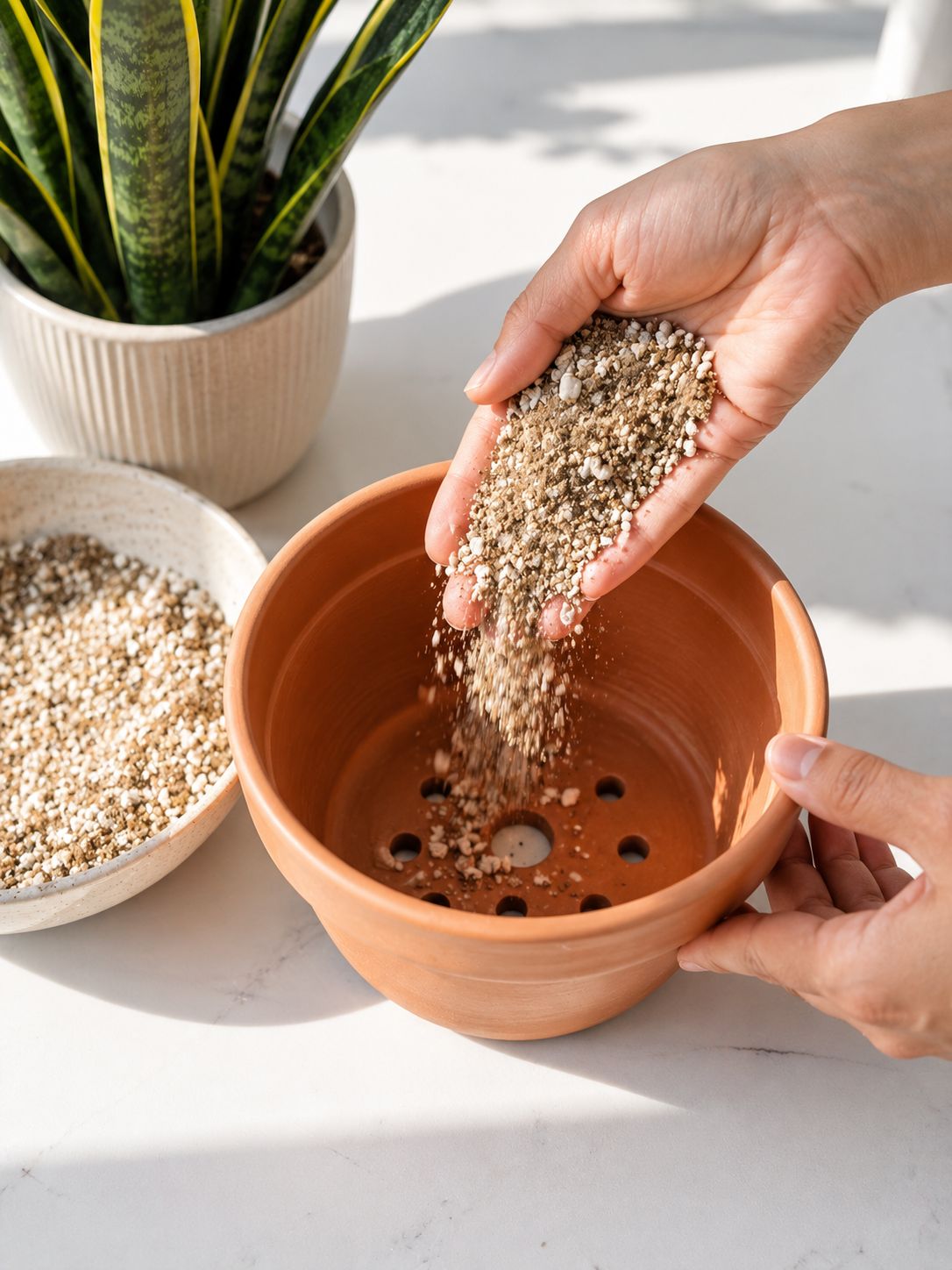
Getting soil and pot right for a snake plant is the single most important setup decision you make. Get this wrong and overwatering — the main killer of snake plants — becomes inevitable.
Soil:
Snake plants grow in dry, rocky, sandy soil in their native West Africa. Compact, moisture-retaining potting soil — the standard kind sold for most houseplants — holds far too much water for them and leads directly to root rot.
Use a cactus or succulent potting mix as your base. Improve it further by mixing in perlite or coarse sand for additional drainage. A good ratio is 60% cactus mix and 40% perlite. This light, gritty mix mimics their native sandy habitat, drains fast, and keeps roots dry between waterings.
Heavy soils trap water and starve roots of oxygen, leading to mushy, rotten bases. Switching to a cactus compost mix with grit and perlite makes a night and day difference to plant health.
Pot:
Terracotta pots are the best choice for snake plants. They are porous — they wick away excess moisture through the walls — and they provide natural insulation for roots. Drainage holes at the bottom are absolutely non-negotiable. A pot without drainage is a death sentence for a snake plant.
Some snake plants grow tall and top-heavy. Make sure your decorative pot is heavy enough to stop it from toppling over — a wide base or a weighty ceramic outer pot prevents this.
Do not rush to repot a newly purchased snake plant. Snake plants actually prefer being slightly root-bound — they grow well when their roots fill the pot. You can probably keep your snake plant in its original nursery pot for a long while, unless its roots are bursting out of the bottom.
Step 03 — Watering: Less Is Always More
This is where snake plants are killed. Not by neglect — by too much love.
Snake plants are drought-tolerant succulents. They store water in their thick, fleshy leaves. Overwatering suffocates the root system and invites rot. Soil that is on the dry side is much better than soggy soil.
The rule is simple: only water when the soil is completely dry.
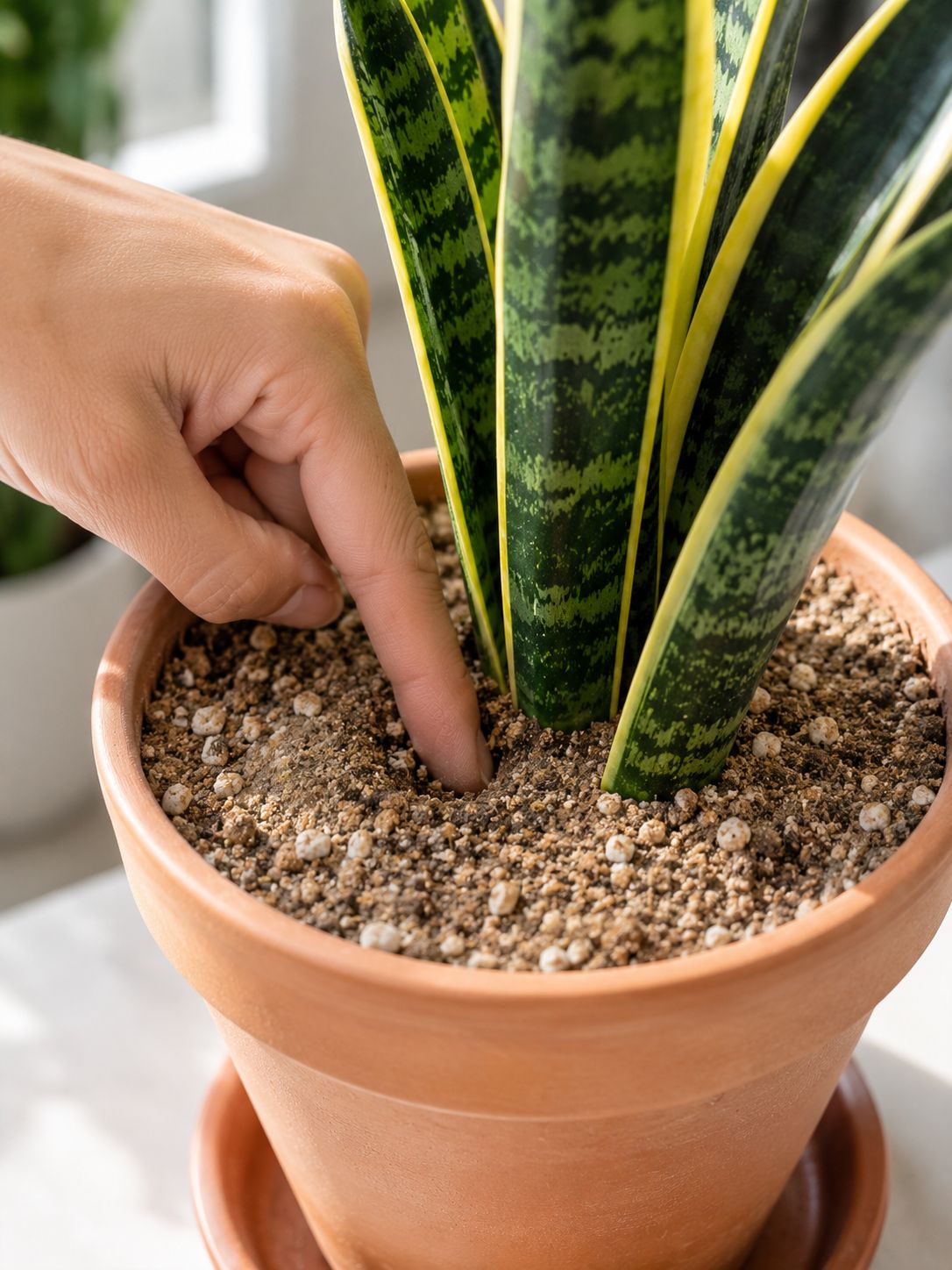
Insert your finger two to three inches deep into the soil. If it feels even slightly damp, do not water. If it feels dry all the way down, water thoroughly — enough that water drains fully from the bottom of the pot — and then do not water again until the soil dries out completely.
How often that happens depends on your conditions:
| Season | Typical Watering Frequency |
|---|---|
| Pakistani Summer (hot, bright) | Every 2–4 weeks |
| Pakistani Winter (cool, less light) | Every 4–8 weeks |
| Very low light conditions | Every 6–8 weeks or less |
| Bright indirect light | Every 2–3 weeks |
These are guides, not schedules. The finger test is always more reliable than a calendar. Never water on a fixed day of the week — water based on what the soil is actually doing.
One specific warning: Water less in winter, when cooler temperatures and lower light slow growth to almost nothing. A snake plant barely transpires in winter — it needs almost no water during this period. Many people kill their snake plant in winter by continuing to water it at the same frequency as summer.
⚠️ Signs of overwatering: Soft, mushy leaves especially at the base. Yellowing lower leaves. A foul smell from the soil. These are the early signs of root rot — act immediately by letting the soil dry completely and checking roots.
Step 04 — Feeding and Seasonal Care
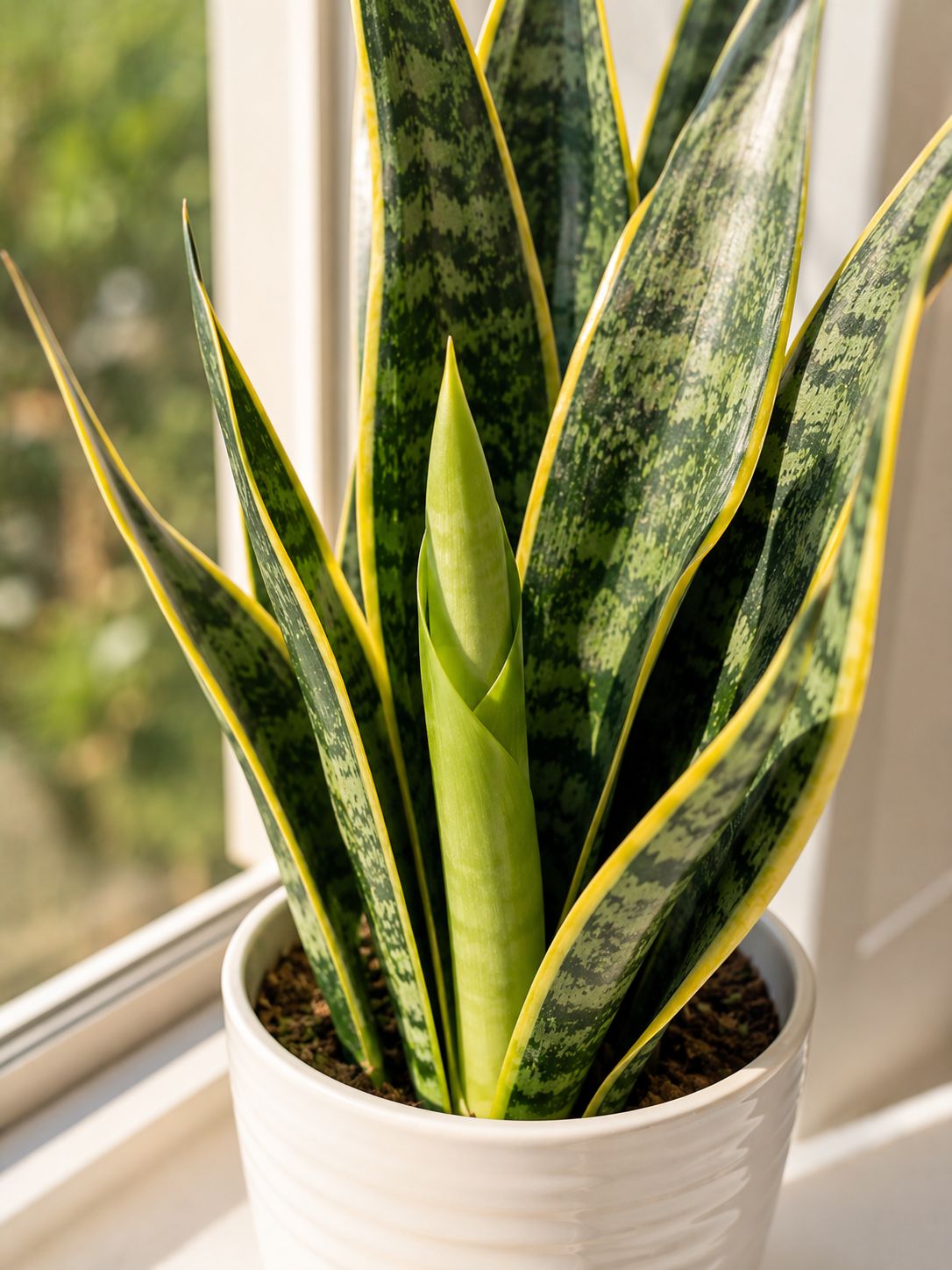
Snake plants need very little fertiliser — they can survive in poor soil for extended periods. But a small amount of feeding during the active growing season produces noticeably healthier, faster-growing plants.
When to feed: Spring and summer only — this is when the plant is actively growing. Feed with a balanced liquid houseplant fertiliser once a month. Do not fertilise in autumn or winter when the plant has slowed or stopped growing — unused fertiliser builds up as salt in the soil and damages roots over time.
What to use: A diluted liquid fertiliser at half the recommended strength is ideal. Snake plants are light feeders — the standard dose on a bottle is usually too strong. A 10-10-10 balanced formula works well.
Seasonal care notes:
- Spring: The plant wakes up and begins pushing new leaves from the centre. Increase watering slightly. Resume monthly feeding. This is the best time to repot or propagate.
- Summer: Most active growth period. Keep away from harsh afternoon sun. Water more frequently but only when soil is dry. Wipe leaves occasionally with a damp cloth to remove dust — this genuinely helps the plant absorb more light.
- Autumn: Growth slows. Begin tapering fertiliser and watering. Move away from cold draughts as temperatures drop.
- Winter: Plant goes nearly dormant. Water very infrequently. No fertiliser. Move away from cold windows. Keep away from air conditioning or heating vents that produce dry, extreme-temperature airflow.
🌿 Leaf wiping: Giving leaves a gentle wipe with a clean, damp cloth every few weeks removes the layer of dust that accumulates indoors in Pakistani cities. This is not just cosmetic — a dusty leaf absorbs light less efficiently. Clean leaves photosynthesise better and look genuinely glossier and more beautiful.
Step 05 — Propagation: One Plant Becomes Many
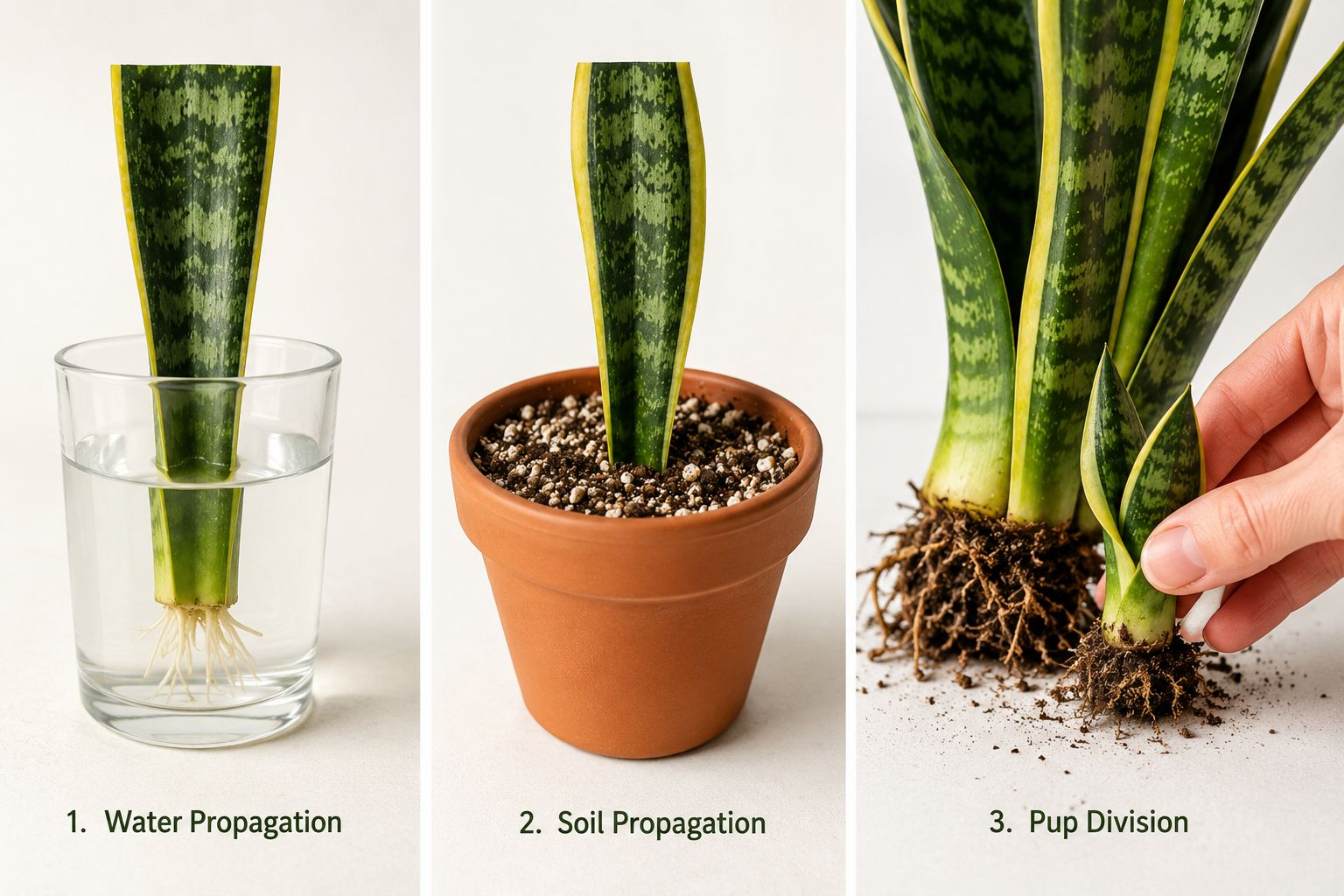
Snake plants are one of the easiest houseplants to propagate. One healthy plant can produce dozens of new plants over time — for free, for gifts, or to fill more rooms with greenery.
Method 1 — Division (Best, Preserves Variegation)
When your snake plant produces offshoots — small new plants called pups that emerge from the soil beside the main plant — you can separate them and pot them independently. This is the best propagation method because the new plant is genetically identical to the parent, including any variegation or colouring.
Carefully remove the plant from its pot in spring. Identify the pups and their root systems. Separate them from the parent with a clean, sharp knife if they are not already naturally separated. Pot each pup into its own container with fresh cactus mix. Water once and leave in bright indirect light.
Method 2 — Leaf Cutting in Water
Cut a healthy leaf near the base with clean scissors. Place the cut end in a glass of water — just 5 cm submerged. Keep in bright indirect light and change the water every few days. Roots will appear in four to eight weeks. Once roots are 3–5 cm long, transfer to soil.
Important note on water propagation: When a new snake plant is created from a cutting its unique foliage patterns — variegation, golden edges, coloured borders — are usually lost. The new plant will grow with solid green leaves. If you want the same colouring as the parent, divide rather than cut.
Method 3 — Leaf Cutting in Soil
Cut a leaf into sections about 7–10 cm long. Note which end is the bottom — the end that was closest to the soil. Plant bottom-end-down about 2–3 cm deep into moist cactus mix. Keep in warm, bright indirect light. New roots and eventually a new pup will emerge over the next 4–8 weeks.
Propagate during spring or early summer for the best success rates — this is when the plant is in active growth and roots form most readily.
Repotting — When and How
Snake plants are slow growers and prefer being slightly root-bound. Repot every two to three years or when you can see roots circling inside the pot, roots sneaking through drainage holes, or the plant visibly struggling despite good care.
Always go up just one pot size — a pot that is too large holds too much soil and too much moisture, which leads directly to root rot. Choose a heavy, stable pot to prevent toppling.
Spring is the best time to repot. Use fresh cactus or succulent mix. After repotting, wait a week before watering — this lets any disturbed roots settle and reduces the risk of rot through damaged root tissue.
Common Problems and How to Fix Them
| Problem | Cause | Fix |
|---|---|---|
| Yellow, soft, mushy leaves | Overwatering — root rot beginning | Stop watering immediately. Check roots. Remove any rotted roots. Repot in fresh dry cactus mix |
| Brown, crispy leaf tips | Too much direct harsh sun or dry air from AC | Move away from direct afternoon sun. Keep away from AC vents |
| Drooping, floppy leaves | Overwatering or very low light | Let soil dry completely. Move to brighter spot |
| Pale, washed-out colour | Too much direct harsh sun | Move to bright indirect light |
| Slow or no growth | Low light or winter dormancy | Move to brighter spot or accept winter slowdown — it is normal |
| White crusty residue on soil | Salt build-up from over-fertilising | Flush soil with plain water. Reduce fertiliser frequency |
| Leaves leaning to one side | Light from one direction only | Rotate pot 180° every two weeks |
| Pests — mealybugs or spider mites | Dust, dry air, stressed plant | Wipe leaves with rubbing alcohol on a cotton pad. Treat with neem oil spray |
Snake Plant vs Other Popular Indoor Plants
| Snake Plant | Pothos | Peace Lily | ZZ Plant | Spider Plant | |
|---|---|---|---|---|---|
| Low light tolerance | ✅ Excellent | ✅ Good | ✅ Good | ✅ Excellent | 🔶 Moderate |
| Watering frequency | Every 2–6 weeks | Weekly | Weekly | Every 2–4 weeks | Weekly |
| Beginner friendly | ✅ Best | ✅ Yes | 🔶 Medium | ✅ Yes | ✅ Yes |
| Air benefits | ✅ Yes | 🔶 Moderate | ✅ Yes | 🔶 Moderate | 🔶 Moderate |
| Propagation ease | ✅ Very easy | ✅ Very easy | 🔶 Division | ✅ Easy | ✅ Easy |
| Toxic to pets | ⚠️ Mildly toxic | ⚠️ Mildly toxic | ⚠️ Toxic | ⚠️ Mildly toxic | ✅ Safe |
| Looks architectural | ✅ Yes | ❌ | ❌ | 🔶 Modern | ❌ |
⚠️ Pet safety note: Snake plants contain saponins and are mildly toxic to cats and dogs if ingested — they can cause nausea, vomiting, and diarrhoea. If you have pets that chew on plants, keep the snake plant out of their reach or choose a pet-safe alternative.
The Honest Truth About Snake Plants and Air Purification
You will see snake plants described everywhere as miracle air purifiers that clean your entire home. The truth is slightly more nuanced and worth knowing.
NASA's 1989 Clean Air Study was conducted in sealed, controlled laboratory chambers — not in normal ventilated homes or apartments. In a typical room with air movement and airflow, the air-purifying effect of a single plant is measurable but modest. You would need many plants to achieve the same effect as the sealed chamber results.
That said — snake plants do filter air. They do remove formaldehyde, benzene, xylene, and toluene to a genuine, documented degree. They do release oxygen at night through CAM photosynthesis, which is unusual and real. And the psychological and wellbeing benefits of having plants in a space are consistently supported by research.
The honest position: snake plants will not transform your air quality on their own — but they do contribute to it, they look beautiful doing it, and the other benefits are real.
Quick Care Summary
| Care | Requirement |
|---|---|
| ☀️ Sunlight | Bright indirect to low light — avoid harsh afternoon sun |
| 💧 Watering | Only when soil is completely dry — every 2–6 weeks |
| 🌡️ Temperature | 15–30°C ideal — keep above 10°C |
| 🪴 Pot | Terracotta with drainage holes — slightly root-bound is fine |
| 🌱 Soil | Cactus / succulent mix with added perlite |
| 🌿 Feeding | Balanced liquid fertiliser — once monthly, spring and summer only |
| 📅 Repotting | Every 2–3 years — go up one size only |
| ✂️ Propagation | Division (best), water cutting, soil cutting |
By Seedora Store — your guide to indoor plants that actually work in Pakistani homes and apartments.
Part of the Seedora Indoor Plants Series — paired with the Instantly Grow Series on kitchen herbs and vegetables.