On the morning of December 8, 1941 — the day after Pearl Harbor — the most powerful military in the world woke up to a problem that had nothing to do with battleships.
The United States consumed nearly 60 percent of the world's rubber supply. Its military ran on rubber — tires on every truck, jeep, and aircraft, fuel tank liners, gas masks, life rafts, boots, electrical insulation, conveyor belts, engine gaskets. Without rubber, mechanised warfare was impossible. And in the hours after Pearl Harbor, American strategists understood something that would define the next four years.
They had almost none of it.
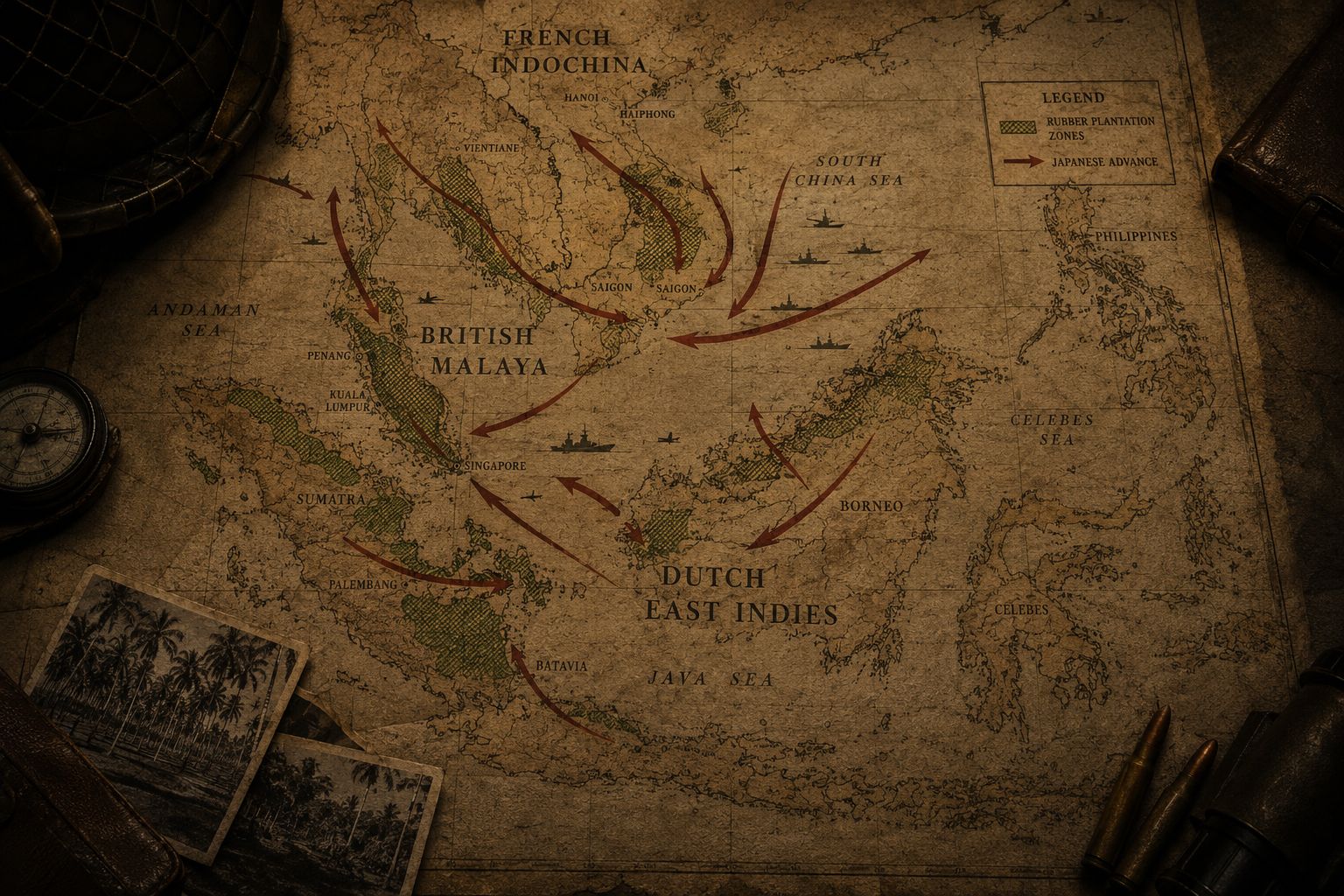
Ninety-six percent of the world's rubber came from plantations in Southeast Asia — British Malaya, the Dutch East Indies, French Indochina. And Japan, with a speed and precision that stunned Allied commanders, was in the process of taking all of it.
This is the story of a tree. A single species — Hevea brasiliensis — that began its life in the Amazon rainforest, was stolen by a Victorian botanist, transplanted across the world, and became the most strategically important plant of the twentieth century. A plant so valuable that nations went to war over it, and whose absence nearly ended the Allied cause before it had properly begun.
The Tree That Bleeds White
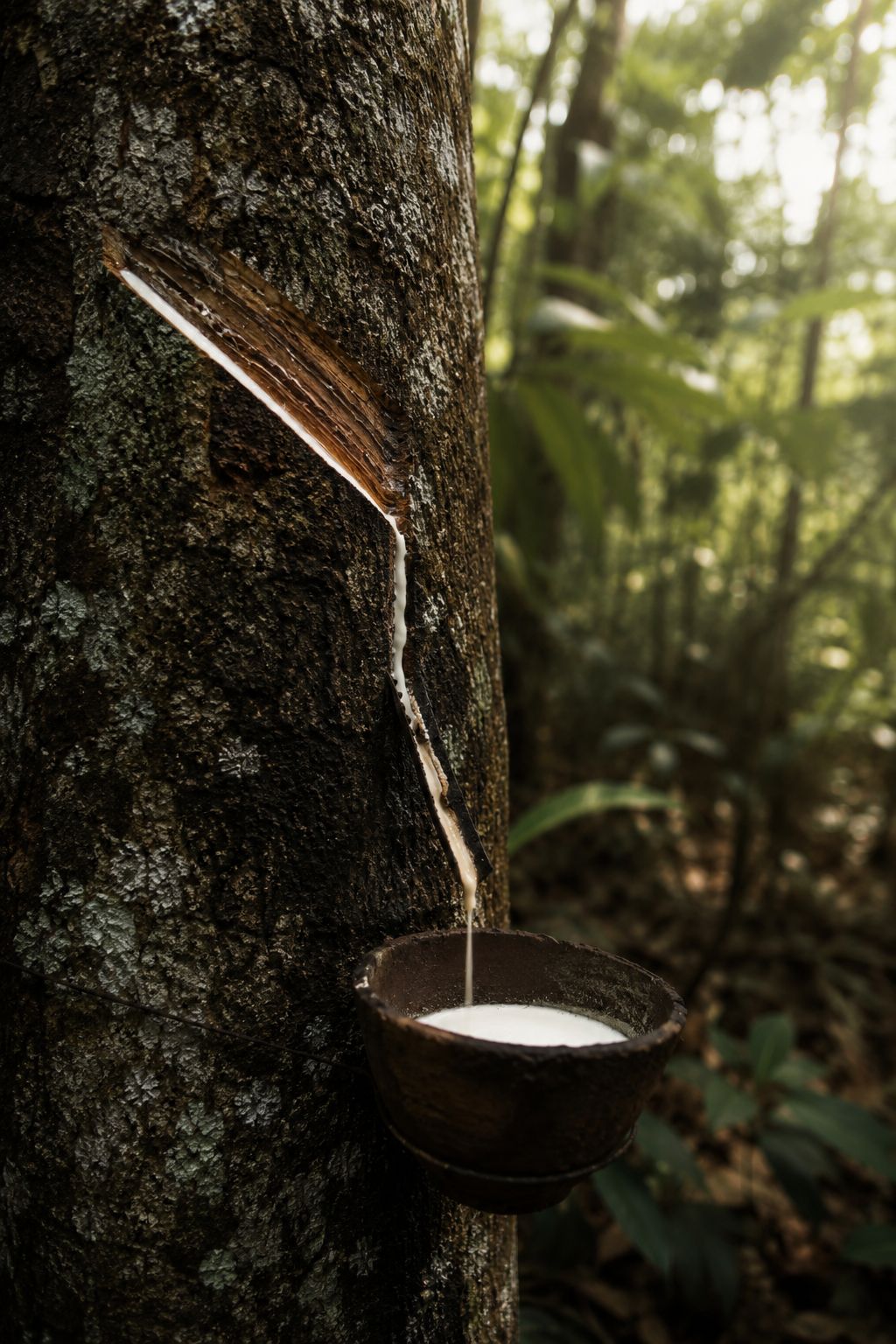
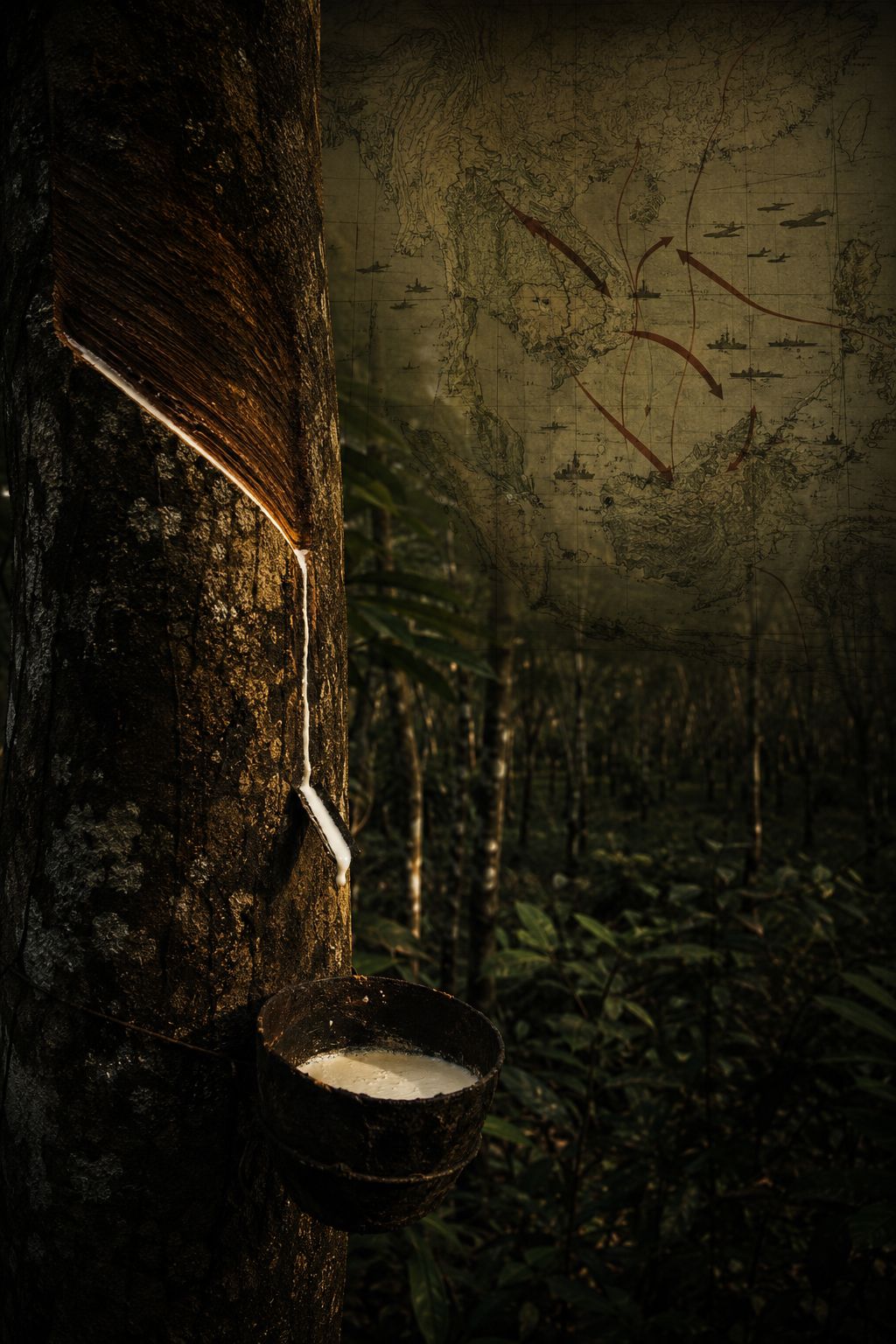
Hevea brasiliensis is a tall tropical tree — reaching 30 to 40 metres in its natural state — native to the Amazon basin of South America. It produces latex, a milky white fluid that runs beneath the bark and serves as the tree's defence against insects and damage. When a cut is made in the bark, the latex flows. Collected, processed, and vulcanised, it becomes natural rubber — one of the most versatile materials ever discovered.
The indigenous peoples of the Amazon had known about it for centuries. They waterproofed clothing with it, made balls from it, used it for containers and footwear. European explorers encountered it in the eighteenth century and brought samples back to scientists who were fascinated but could not initially find widespread industrial use.
That changed in 1839. Charles Goodyear discovered vulcanisation — the process of heating rubber with sulphur — which transformed a material that became brittle in cold and sticky in heat into something stable, strong, and elastic across a wide range of temperatures. The industrial revolution had already begun generating machines that needed seals, belts, and insulation. Vulcanised rubber could provide all of them.
Then came the bicycle. Then the automobile. And rubber, overnight, became the most sought-after raw material on earth.
The rubber tree takes seven years to reach maturity. After that, a tapper makes a precise diagonal incision in the bark each morning and collects the latex that flows through the day. One tree yields approximately three to four kilograms of dry rubber per year. It is skilled, labour-intensive, time-sensitive work — and it requires the right climate. Hevea brasiliensis only grows well within roughly ten degrees of the equator, in humid tropical conditions with significant rainfall.
Brazil had the trees. But Brazil had not organised the plantations that the industrial world needed.
The Great Theft
In 1876, a British botanist named Henry Wickham boarded a ship in the Brazilian port of Santarém with 70,000 rubber tree seeds hidden in banana leaves among his cargo. He told Brazilian customs officials the cargo was botanical specimens for the Royal Gardens at Kew — which was technically true, but not the complete picture. Brazil's rubber trade was the foundation of its economy. The export of seeds was effectively prohibited. Wickham got them out anyway.
At Kew Gardens in London, the seeds were germinated. Seedlings were sent to Ceylon and Singapore. From those seedlings, British colonial botanists developed rubber plantations across Malaya and other territories in Southeast Asia, where the climate matched the Amazon but the labour was cheaper and the organisation more systematic.
By the early twentieth century, the Amazon's rubber monopoly was finished. Malayan plantations — methodically planted, scientifically managed, running on colonial labour — were producing rubber at a fraction of the cost and in quantities Brazil could not match. By the 1930s, Southeast Asia accounted for 96 percent of global natural rubber production.
The entire global industrial economy was now dependent on rubber from a narrow band of tropical territory controlled by British, Dutch, and French colonial governments.
And Japan was watching.
Japan's Calculation
Japan in the 1930s was a rapidly expanding industrial and military power with a fundamental resource problem. It had almost no domestic oil and no natural rubber whatsoever. Everything its growing economy and military needed — oil, rubber, tin, bauxite — had to be imported.
Before the war, Japan imported the majority of its rubber from the American Philippines, the Dutch East Indies, and British Malaya. The United States and Britain, increasingly alarmed by Japanese expansion in China, began cutting off those supply lines. In 1941, the US imposed an oil embargo. The Dutch East Indies, under Allied pressure, restricted rubber and oil exports to Japan.
Japan faced a choice: accept resource strangulation and limit its ambitions, or seize the resources directly.
The decision was made. The attack on Pearl Harbor on December 7, 1941 was not simply an attempt to destroy the US Pacific Fleet. It was cover for a simultaneous, coordinated invasion of Southeast Asia — specifically designed to capture the rubber plantations of Malaya and the oil fields of the Dutch East Indies before the Allies could respond.
The Japanese military moved with extraordinary speed. Singapore — the supposedly impregnable British fortress and the centre of Malayan rubber production — fell on February 15, 1942. The Dutch East Indies surrendered in March. Within months, Japan controlled the rubber plantations that produced 96 percent of the world's supply.
Rubber was the only bulk industrial commodity more readily available to Japan than the United States before the war, according to analysis from the Pacific War Online Encyclopedia. After the fall of Singapore, that advantage became near-absolute.
America's Crisis
The magnitude of the problem that hit the United States in early 1942 is difficult to overstate.
Before Pearl Harbor, the US had stockpiled approximately 540,000 tons of rubber. Military and civilian demand together ran at roughly one million tons per year. The math was not complicated. Without a new supply of rubber, the United States would exhaust its reserves within months.
The War Production Board, established by President Roosevelt in January 1942, classified rubber alongside oil and steel as the most critical strategic materials of the entire war effort. A report delivered to Roosevelt in 1942 stated directly: of all critical and strategic materials, rubber is the one which presents the greatest threat to the safety of our nation and the success of the Allied cause.
The consequences of the shortage were immediate and felt by ordinary civilians. Rubber rationing was imposed. The national speed limit was reduced to 35 miles per hour — not to save fuel, but to reduce tire wear. New car tires were banned for civilian sale. Americans were asked to donate rubber — old garden hoses, floor mats, raincoats, shoes — to collection drives. Rubber recycling became a patriotic duty.
None of it was enough to address a shortage measured in hundreds of thousands of tons.
Three parallel solutions were pursued simultaneously, with an urgency that bordered on desperation.
The Three Escapes
The First Escape: Synthetic Rubber
Nazi Germany had been developing synthetic rubber since the 1930s — Buna rubber, made from coal tar derivatives — partly because Germany had no tropical colonies and understood its vulnerability. The Soviet Union had made similar progress. The United States had lagged far behind, partly because access to cheap natural rubber from Allied-controlled Malaya had removed the economic incentive to develop an alternative.
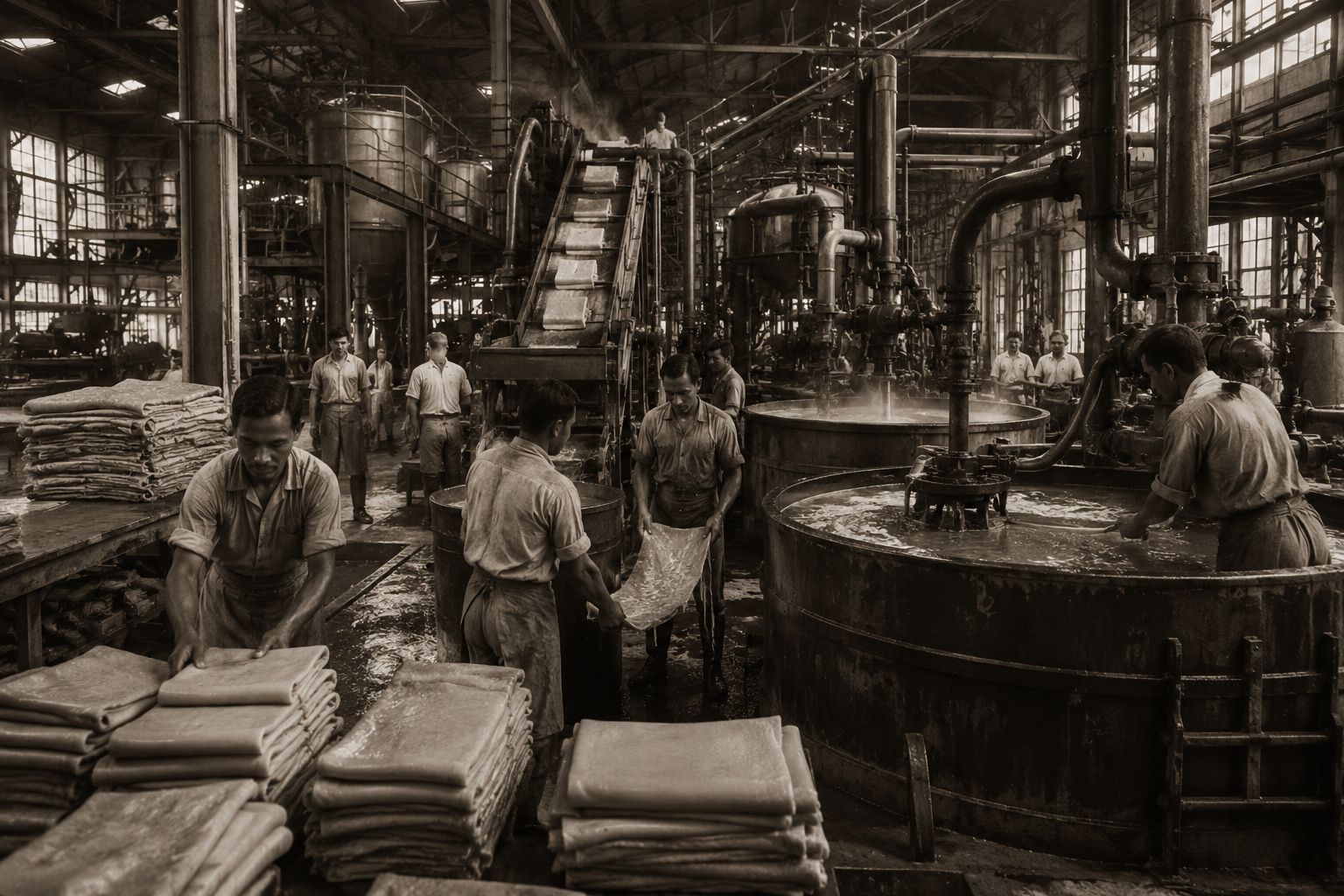
Pearl Harbor changed the calculation instantly. Hundreds of millions of dollars flooded into synthetic rubber research and production. Scientists from Standard Oil, DuPont, and dozens of universities and government laboratories worked around the clock. The breakthrough came with styrene-butadiene rubber — SBR — made from petroleum derivatives. By the end of 1942, the first synthetic rubber plants were producing. By 1944, the United States was producing more than 700,000 tons of synthetic rubber per year — more than enough to meet military demand.
It was one of the most remarkable industrial mobilisations in history. A country that was producing essentially zero synthetic rubber in 1941 built, within three years, the largest synthetic rubber industry in the world.
The Second Escape: Brazil's Rubber Soldiers
In the depths of the Amazon, the trees that had started everything were still standing. Brazil, now an Allied partner, agreed to massively expand Amazon rubber production. The Brazilian government recruited tens of thousands of workers — mostly desperately poor men from the drought-stricken northeast of the country — and sent them into the jungle to tap wild rubber trees.
These men became known as the soldados da borracha — the rubber soldiers. They were sent to an unfamiliar, dangerous environment with inadequate supplies and medical support. Malaria, yellow fever, and accidents killed thousands of them. Of the approximately 55,000 men recruited, estimates suggest that between 20,000 and 30,000 died in the Amazon, a death rate comparable to some of the bloodiest conventional military campaigns of the war.
They received almost no official recognition for decades. Brazil only formally recognised the rubber soldiers as war veterans in 1988 — more than forty years after the war ended.
The Third Escape: The Desert Plant
The third solution was the strangest. Guayule — a small desert shrub native to the American Southwest and northern Mexico — had been known since the early twentieth century to contain natural rubber in its stems and roots. It was not as productive as Hevea, but it grew in climates where Hevea could not survive.
In a scenario stranger than fiction, Japanese-American internees at the Manzanar War Relocation Center in California — people imprisoned by the US government for the crime of their ancestry — were asked to grow and harvest guayule as part of the war rubber programme. They did. Working in the very desert to which they had been forcibly relocated, they produced rubber for the country that had imprisoned them.
The guayule programme ultimately produced only a small fraction of total rubber needs, but it pointed toward something important: the global economy's dependence on a single tree species from a single region was a strategic vulnerability that a desert shrub might, one day, help address.
What the Tree Left Behind
The war ended in 1945. Synthetic rubber, born of crisis and necessity, did not disappear with it. Today, synthetic rubber accounts for approximately 60 to 70 percent of global rubber consumption. The industrial world discovered during the crisis of 1942 that it did not have to depend entirely on a single tropical tree, and the lesson stuck.
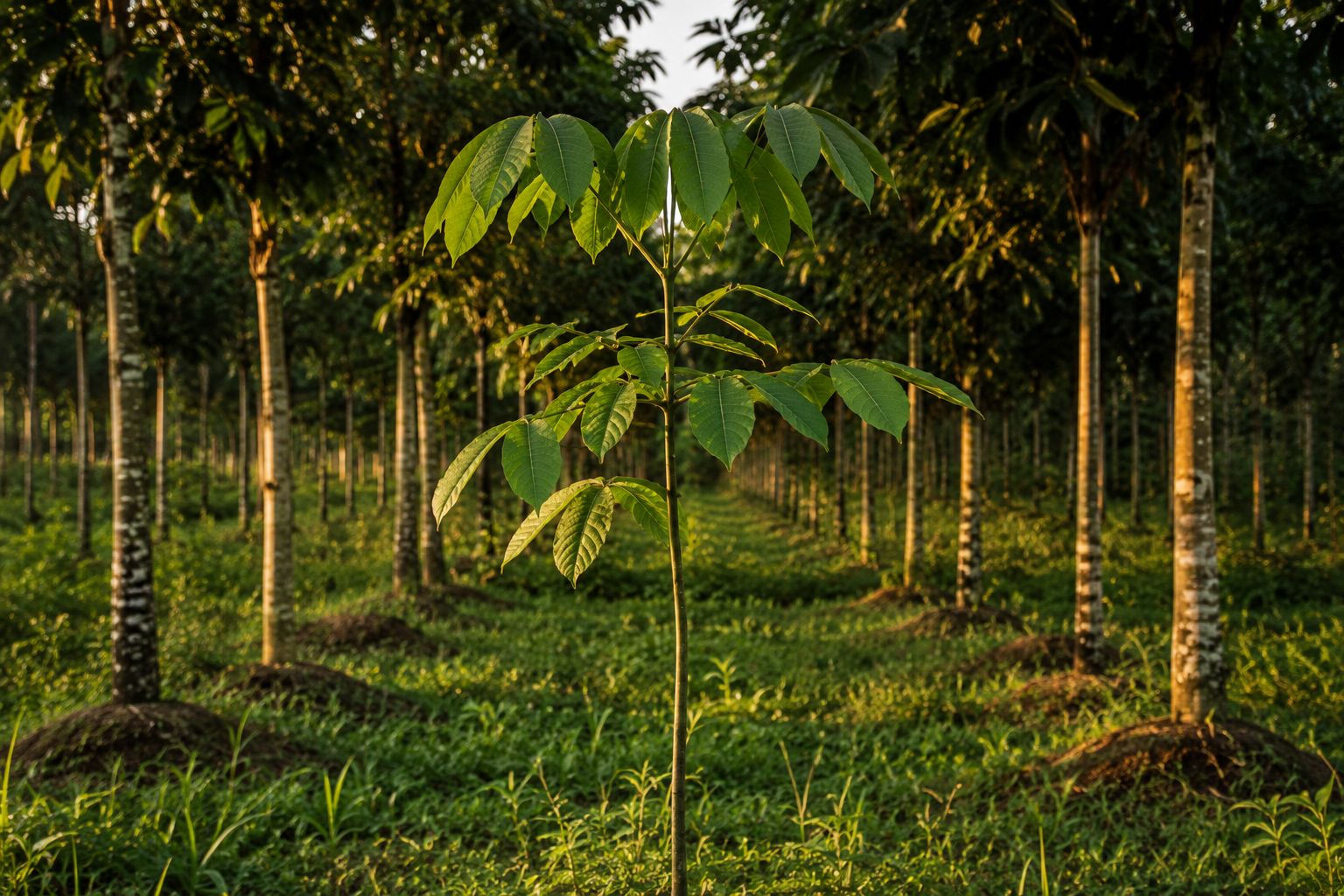
But natural rubber — from Hevea brasiliensis — still accounts for 40 percent of global rubber production. It remains irreplaceable for certain applications, particularly high-performance tires for aircraft, where the heat dissipation properties of natural rubber cannot be replicated synthetically. The trees still grow in the plantations that Wickham's stolen seeds established in the 1870s. The industry built on colonial labour and imperial calculation is still running.
And Hevea brasiliensis itself faces a threat that plant scientists describe with the same vocabulary strategists used in 1942. The global plantation stock of rubber trees has almost no genetic diversity — all of it descends from a narrow founding population. A fungal disease called South American leaf blight — Microcyclus ulei — devastated Amazon rubber trees in the past and has so far not reached the Southeast Asian plantations. Plant pathologists at institutions including the Science History Institute and Kew Gardens have warned for years that if it does, the consequences for the global rubber supply could be catastrophic.
The vulnerability that Japan exploited in 1941 has a modern equivalent. And the tree at the centre of it is exactly the same.
The Tree in Your Home
The rubber tree most commonly sold in garden centres and plant shops — the plant you might have in your living room right now — is Ficus elastica, the Indian rubber tree. It is a different species from Hevea brasiliensis and produces latex in smaller quantities through the same general mechanism. It shares a name, a family resemblance, and the same milky sap that made it economically interesting in the early industrial era before Hevea took over.
It is a beautiful, low-maintenance houseplant with large, glossy, dark leaves that suits almost any interior. Its connection to one of the most strategically consequential trees in human history is not something most people who own one ever think about.
But behind every plant, there is a story. Some of those stories are gentle and botanical. Some of them moved armies, reshaped empires, and decided wars.
This one did all three.
By Seedora Store — History and Culture Series.
Uncover the stories, legends, and historical events hidden behind the plants we grow today.
Sources: Pacific War Online Encyclopedia, rubber strategic resource analysis; Science History Institute, guayule at Manzanar (2023); American Affairs Journal, US synthetic rubber programme (2025); US Naval Institute Proceedings, rubber and the Pacific War (June 2024); Quintus Curtius, Brazil's rubber soldiers; National Park Service, guayule at Manzanar; FRANKI T, the story of rubber (2025); US War Production Board rubber report (1942), cited in American Affairs Journal.